Anti-DDoS research part 3: SYN flood detection with handshake asymmetry. Simple C, Python examples.
﷽
Hello, cybersecurity enthusiasts and white hackers!
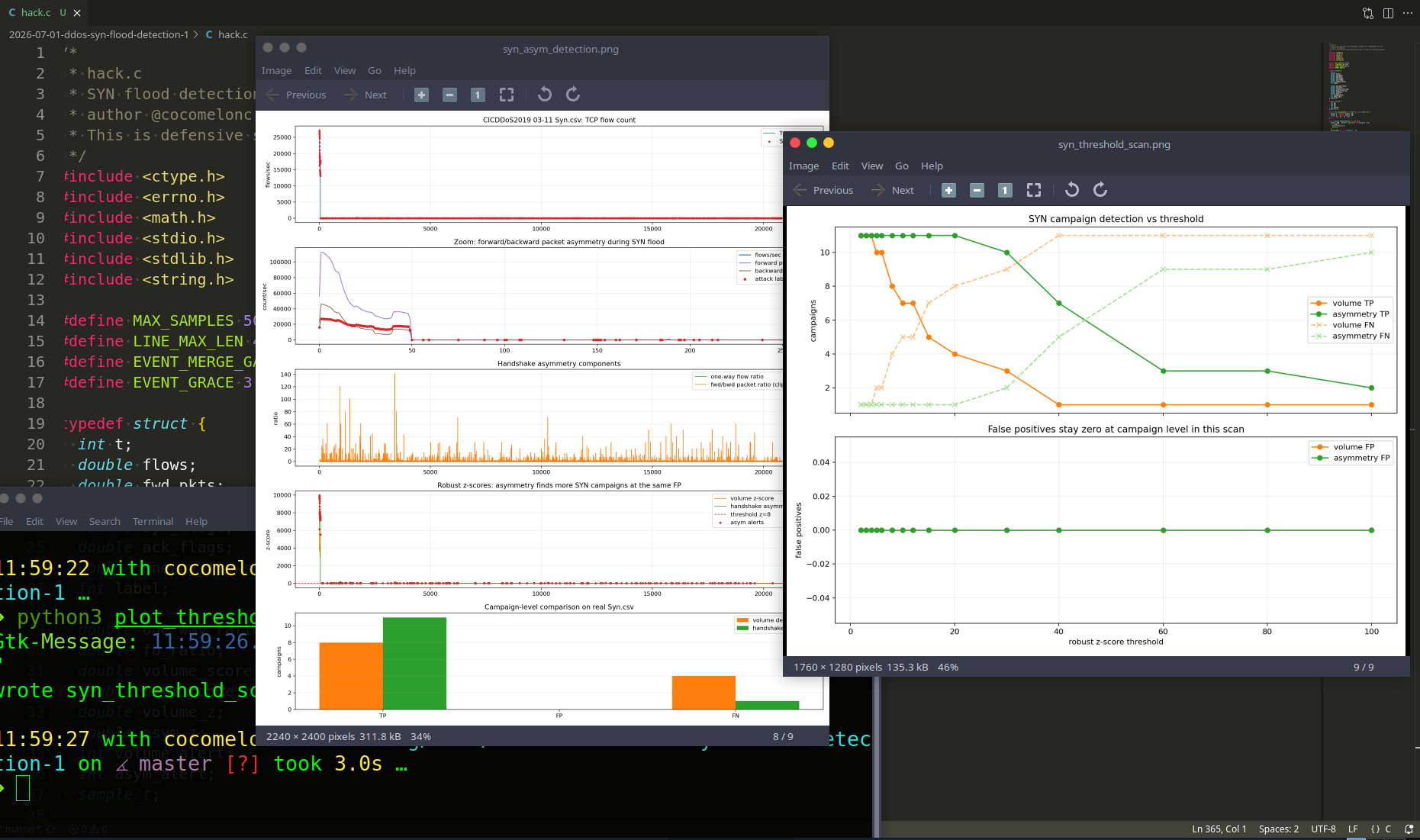
In the previous Anti-DDoS posts I used wavelets for traffic anomaly detection. Today I want to switch from generic signal processing to a protocol-aware detector.
The target is a classic L4 attack:
TCP SYN flood.
No production architecture. No private telemetry. No attack tooling. Just defensive analysis on the public CICDDoS2019 Syn.csv file.
idea
A simple SYN flood detector can look only at volume:
TCP flows/sec
packets/sec
SYN packets/sec
This is useful, but not enough as a general principle. The cybersecurity meaning of SYN flood is not just “many packets”. It is:
many connection attempts without proportional handshake completion.
The TCP handshake is:
client -> server: SYN
server -> client: SYN-ACK
client -> server: ACK
For a healthy service, request and response directions should have some symmetry. During a SYN flood, the forward direction becomes much stronger than the backward/completed side.
In CICFlowMeter CSV we do not have perfect kernel TCP state. But we do have useful flow-level proxy fields:
Total Fwd Packets
Total Backward Packets
SYN Flag Count
ACK Flag Count
Label
Timestamp
Protocol
So we can build a practical approximation of handshake asymmetry.
dataset
I use the real CICDDoS2019 file:
./03-11/Syn.csv
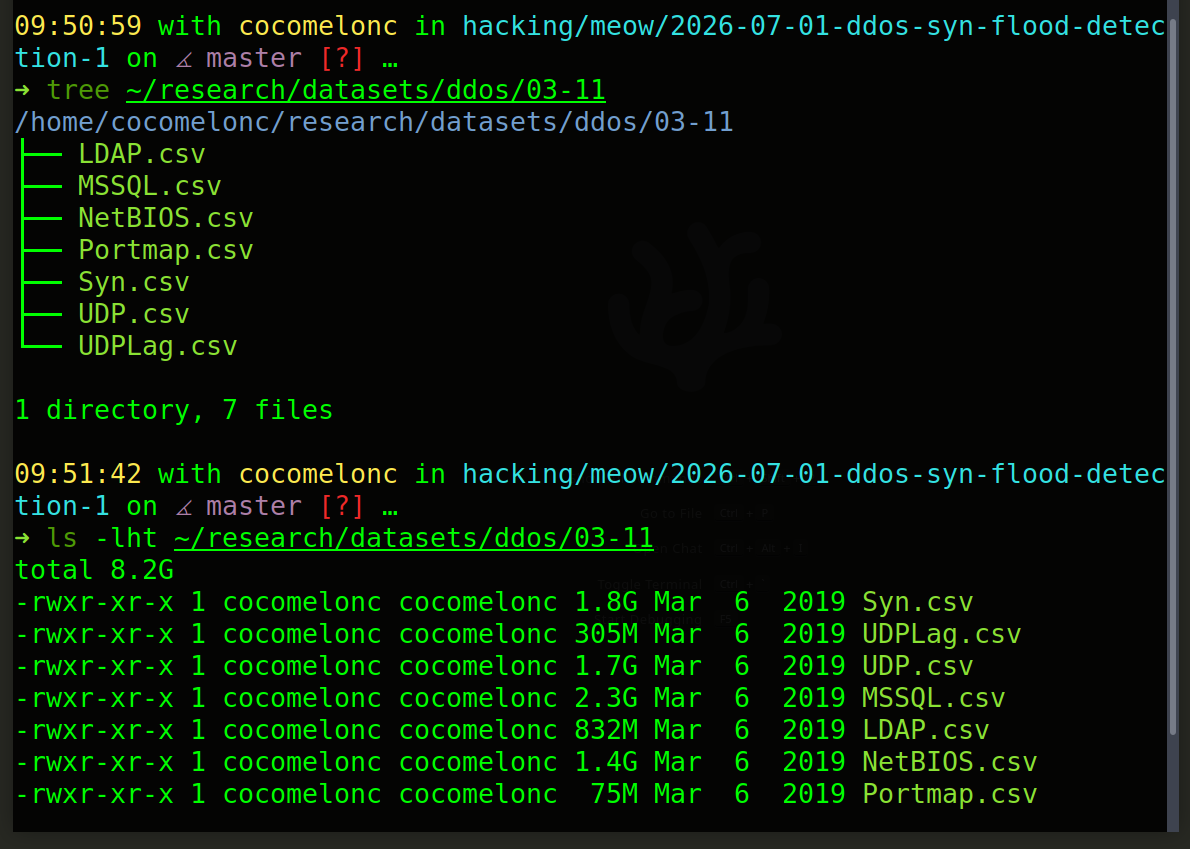
As you can see, this file is large:
1.8 GB
The preparation script streams it line by line and aggregates it into seconds. It does not load the whole CSV into memory.
Run:
python3 prepare_syn_real.py \
  --input /home/cocomelonc/research/datasets/ddos/03-11/Syn.csv \
  -o syn_handshake_timeseries.csv \
  --attack-label Syn
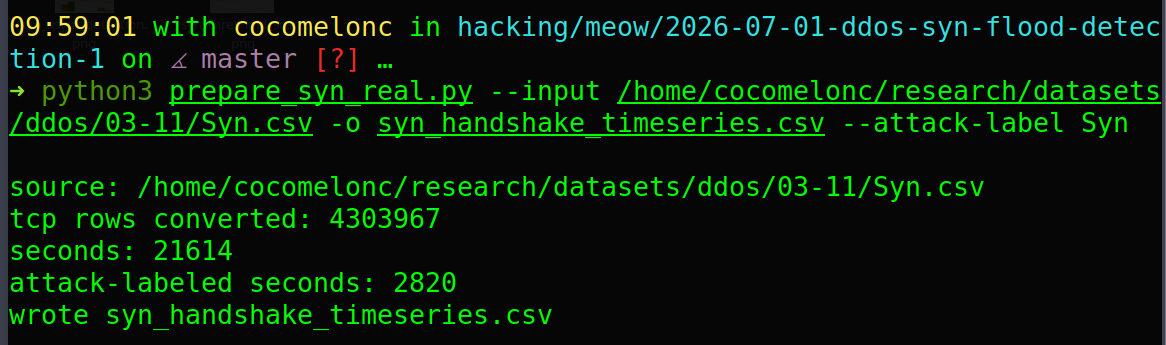
In my case:
source: /home/cocomelonc/research/datasets/ddos/03-11/Syn.csv
tcp rows converted: 4303967
seconds: 21614
attack-labeled seconds: 2820
wrote syn_handshake_timeseries.csv
The output format:
t,flows,fwd_pkts,bwd_pkts,syn_flags,ack_flags,oneway_flows,label
0,16281.0,56014.0,22770.0,4.0,16277.0,8314.0,1
1,27184.0,112916.0,46152.0,4.0,27180.0,12786.0,1
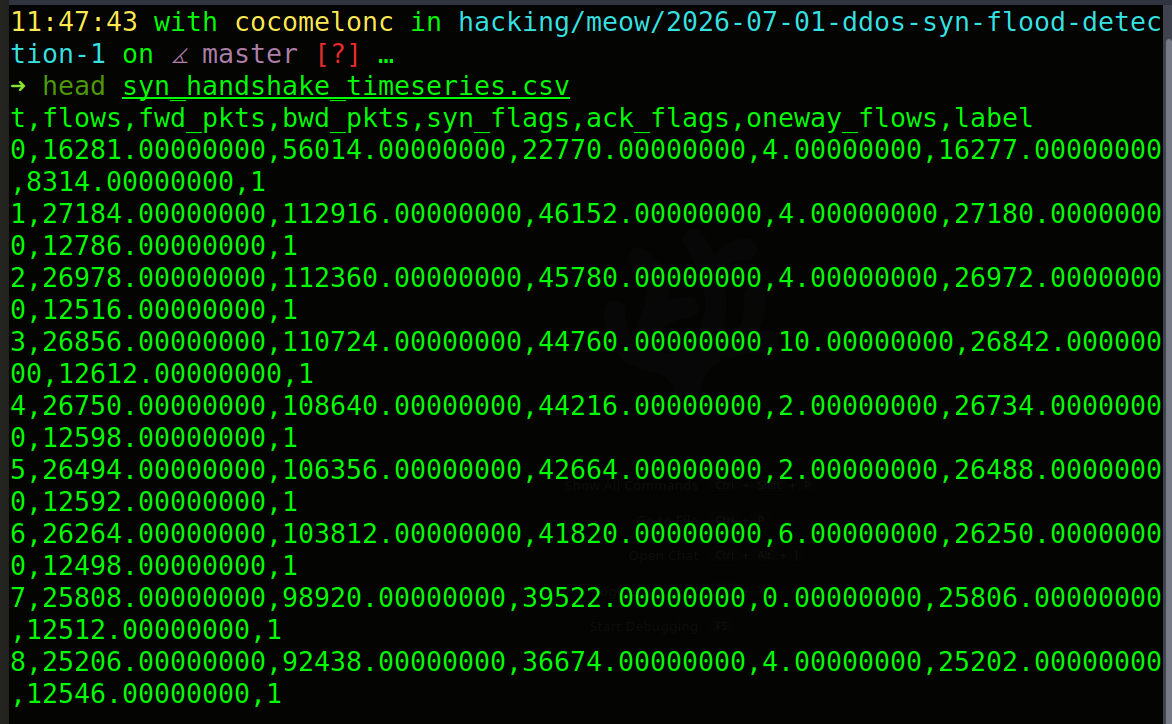
where:
flowsis TCP flows/sec;fwd_pktsis sum ofTotal Fwd Packets;bwd_pktsis sum ofTotal Backward Packets;oneway_flowscounts flows withTotal Backward Packets == 0;label=1meansSynattack was present in that second.
math model
The basic volume detector uses:
\[V_t = flows_t\]This answers:
are there many TCP flows now?
But handshake asymmetry should also consider the response side.
First, define forward/backward packet ratio:
\[R_t = \frac{F_t + 1}{B_t + 1}\]where:
\(F_t\) is forward packets/sec;
\(B_t\) is backward packets/sec;
+1 prevents division by zero.
Then define one-way flow ratio:
\[O_t = \frac{W_t}{flows_t}\]where \(W_t\) is the number of flows with no backward packets.
If flows_t = 0, we set:
The handshake asymmetry score:
\[A_t = flows_t \cdot \log(1 + R_t) \cdot (1 + O_t)\]Why this form?
- \(flows_t\) keeps attack volume.
- \(\log(1+R_t)\) adds directional imbalance but avoids exploding too much.
- \((1+O_t)\) increases score when many flows have no backward side.
This is still simple enough to compute in C.
robust baseline
Raw values are not enough. We need to compare current values to benign baseline.
For any feature \(X_t\), robust z-score is:
\[Z_t = \frac{X_t-\operatorname{median}(B)} {1.4826 \cdot \operatorname{MAD}(B)}\]where:
\[\operatorname{MAD}(B)= \operatorname{median}(|B_i-\operatorname{median}(B)|)\]Important detail: this file has many idle seconds with flows=0. If we include idle seconds in baseline, median and MAD become zero. That is mathematically bad.
So baseline is learned from active benign seconds only:
\[B=\{X_t : label_t=0 \land flows_t>0\}\]This gives a baseline for normal active TCP traffic, not for idle time.
practical example
The core feature calculation:
static void compute_raw_features(sample_t *s, int n) {
  for (int i = 0; i < n; i++) {
    s[i].one_way_ratio = s[i].flows > 0.0 ? s[i].oneway_flows / s[i].flows : 0.0;
    s[i].fb_ratio = (s[i].fwd_pkts + 1.0) / (s[i].bwd_pkts + 1.0);

    s[i].volume_score_raw = s[i].flows;
    s[i].asym_score_raw =
      s[i].flows *
      log1p(s[i].fb_ratio) *
      (1.0 + s[i].one_way_ratio);
  }
}
Then robust normalization:
double volume_med = median(benign_volume, benign_n);
double volume_sigma = 1.4826 * mad(benign_volume, benign_n, volume_med);
double asym_med = median(benign_asym, benign_n);
double asym_sigma = 1.4826 * mad(benign_asym, benign_n, asym_med);

for (int i = 0; i < n; i++) {
  samples[i].volume_z = (samples[i].volume_score_raw - volume_med) / volume_sigma;
  samples[i].asym_z = (samples[i].asym_score_raw - asym_med) / asym_sigma;
  samples[i].volume_alert = samples[i].volume_z > volume_threshold;
  samples[i].asym_alert = samples[i].asym_z > asym_threshold;
}
So, the full source code looks like this hack.c:
/*
 * hack.c
 * SYN flood detection with handshake asymmetry on CICDDoS2019 Syn.csv
 * this is defensive signal-processing code. It does not generate packets.
 * author @cocomelonc
 */
#include <ctype.h>
#include <errno.h>
#include <math.h>
#include <stdio.h>
#include <stdlib.h>
#include <string.h>

#define MAX_SAMPLES 500000
#define LINE_MAX_LEN 4096
#define EVENT_MERGE_GAP 60
#define EVENT_GRACE 3

typedef struct {
  int t;
  double flows;
  double fwd_pkts;
  double bwd_pkts;
  double syn_flags;
  double ack_flags;
  double oneway_flows;
  int label;

  double one_way_ratio;
  double fb_ratio;
  double volume_score_raw;
  double asym_score_raw;
  double volume_z;
  double asym_z;
  int volume_alert;
  int asym_alert;
} sample_t;

typedef struct {
  int tp;
  int fp;
  int fn;
  int events;
} metrics_t;

static int cmp_double(const void *a, const void *b) {
  double x = *(const double *)a;
  double y = *(const double *)b;
  return (x > y) - (x < y);
}

static double median(double *v, int n) {
  double *tmp = (double *)malloc(sizeof(double) * n);
  if (!tmp) {
    perror("malloc");
    exit(1);
  }
  memcpy(tmp, v, sizeof(double) * n);
  qsort(tmp, n, sizeof(double), cmp_double);
  double result = (n % 2 == 0) ? (tmp[n / 2 - 1] + tmp[n / 2]) / 2.0 : tmp[n / 2];
  free(tmp);
  return result;
}

static double mad(double *v, int n, double med) {
  double *dev = (double *)malloc(sizeof(double) * n);
  if (!dev) {
    perror("malloc");
    exit(1);
  }
  for (int i = 0; i < n; i++) {
    dev[i] = fabs(v[i] - med);
  }
  double result = median(dev, n);
  free(dev);
  return result < 1e-9 ? 1e-9 : result;
}

static char *trim(char *s) {
  while (isspace((unsigned char)*s)) {
    s++;
  }
  if (*s == 0) {
    return s;
  }
  char *end = s + strlen(s) - 1;
  while (end > s && isspace((unsigned char)*end)) {
    *end = 0;
    end--;
  }
  return s;
}

static int read_series(const char *path, sample_t *s) {
  FILE *f = fopen(path, "r");
  if (!f) {
    fprintf(stderr, "failed to open %s: %s\n", path, strerror(errno));
    exit(1);
  }

  char line[LINE_MAX_LEN];
  int n = 0;
  int line_no = 0;
  while (fgets(line, sizeof(line), f)) {
    line_no++;
    char *p = trim(line);
    if (*p == 0) {
      continue;
    }
    if (line_no == 1 && strstr(p, "flows") && strstr(p, "label")) {
      continue;
    }

    char *cols[8];
    for (int i = 0; i < 8; i++) {
      cols[i] = strtok(i == 0 ? p : NULL, ",");
      if (!cols[i]) {
        fprintf(stderr, "invalid CSV line %d\n", line_no);
        exit(1);
      }
    }
    if (n >= MAX_SAMPLES) {
      fprintf(stderr, "too many samples\n");
      exit(1);
    }

    s[n].t = atoi(trim(cols[0]));
    s[n].flows = atof(trim(cols[1]));
    s[n].fwd_pkts = atof(trim(cols[2]));
    s[n].bwd_pkts = atof(trim(cols[3]));
    s[n].syn_flags = atof(trim(cols[4]));
    s[n].ack_flags = atof(trim(cols[5]));
    s[n].oneway_flows = atof(trim(cols[6]));
    s[n].label = atoi(trim(cols[7])) != 0;
    n++;
  }

  fclose(f);
  return n;
}

static void compute_raw_features(sample_t *s, int n) {
  for (int i = 0; i < n; i++) {
    s[i].one_way_ratio = s[i].flows > 0.0 ? s[i].oneway_flows / s[i].flows : 0.0;
    s[i].fb_ratio = (s[i].fwd_pkts + 1.0) / (s[i].bwd_pkts + 1.0);

    /*
     * volume_score_raw is a basic flows/sec detector.
     *
     * asym_score_raw is a handshake-pressure proxy:
     * - more flows/sec increases pressure;
     * - high forward/backward packet ratio means weak response symmetry;
     * - one-way flows increase the score.
     */
    s[i].volume_score_raw = s[i].flows;
    s[i].asym_score_raw =
      s[i].flows *
      log1p(s[i].fb_ratio) *
      (1.0 + s[i].one_way_ratio);
  }
}

static int collect_benign(sample_t *s, int n, double *volume, double *asym) {
  int count = 0;
  for (int i = 0; i < n; i++) {
    if (s[i].label) {
      continue;
    }
    if (s[i].flows <= 0.0) {
      continue;
    }
    volume[count] = s[i].volume_score_raw;
    asym[count] = s[i].asym_score_raw;
    count++;
  }
  return count;
}

static metrics_t event_metrics(sample_t *s, int n, int use_asym) {
  metrics_t m = {0, 0, 0, 0};
  unsigned char *covered = (unsigned char *)calloc(n, sizeof(unsigned char));
  if (!covered) {
    perror("calloc");
    exit(1);
  }

  int i = 0;
  while (i < n) {
    if (!s[i].label) {
      i++;
      continue;
    }

    int start = i;
    int end = i;
    int last_attack = i;
    i++;

    while (i < n) {
      if (s[i].label) {
        last_attack = i;
        end = i;
        i++;
        continue;
      }
      if (i - last_attack <= EVENT_MERGE_GAP) {
        end = i;
        i++;
        continue;
      }
      break;
    }

    int grace_end = end + EVENT_GRACE;
    if (grace_end >= n) {
      grace_end = n - 1;
    }

    int detected = 0;
    for (int j = start; j <= grace_end; j++) {
      covered[j] = 1;
      int alert = use_asym ? s[j].asym_alert : s[j].volume_alert;
      if (alert) {
        detected = 1;
      }
    }

    m.events++;
    if (detected) {
      m.tp++;
    } else {
      m.fn++;
    }
  }

  for (i = 0; i < n; i++) {
    int alert = use_asym ? s[i].asym_alert : s[i].volume_alert;
    if (alert && !covered[i]) {
      m.fp++;
    }
  }

  free(covered);
  return m;
}

static void write_results(const char *path, sample_t *s, int n) {
  FILE *f = fopen(path, "w");
  if (!f) {
    fprintf(stderr, "failed to open %s: %s\n", path, strerror(errno));
    exit(1);
  }

  fprintf(f, "t,flows,fwd_pkts,bwd_pkts,syn_flags,ack_flags,oneway_flows,label,one_way_ratio,fb_ratio,volume_raw,asym_raw,volume_z,asym_z,volume_alert,asym_alert\n");
  for (int i = 0; i < n; i++) {
    fprintf(f, "%d,%.8f,%.8f,%.8f,%.8f,%.8f,%.8f,%d,%.8f,%.8f,%.8f,%.8f,%.8f,%.8f,%d,%d\n",
      s[i].t,
      s[i].flows,
      s[i].fwd_pkts,
      s[i].bwd_pkts,
      s[i].syn_flags,
      s[i].ack_flags,
      s[i].oneway_flows,
      s[i].label,
      s[i].one_way_ratio,
      s[i].fb_ratio,
      s[i].volume_score_raw,
      s[i].asym_score_raw,
      s[i].volume_z,
      s[i].asym_z,
      s[i].volume_alert,
      s[i].asym_alert);
  }

  fclose(f);
}

int main(int argc, char **argv) {
  const char *input = "syn_handshake_timeseries.csv";
  const char *output = "syn_asym_results.csv";
  double volume_threshold = 8.0;
  double asym_threshold = 8.0;

  if (argc > 1) {
    input = argv[1];
  }
  if (argc > 2) {
    output = argv[2];
  }
  if (argc > 3) {
    volume_threshold = atof(argv[3]);
  }
  if (argc > 4) {
    asym_threshold = atof(argv[4]);
  }

  sample_t *samples = (sample_t *)calloc(MAX_SAMPLES, sizeof(sample_t));
  if (!samples) {
    perror("calloc");
    return 1;
  }

  int n = read_series(input, samples);
  if (n < 32) {
    fprintf(stderr, "need at least 32 samples\n");
    free(samples);
    return 1;
  }

  compute_raw_features(samples, n);

  double *benign_volume = (double *)malloc(sizeof(double) * n);
  double *benign_asym = (double *)malloc(sizeof(double) * n);
  if (!benign_volume || !benign_asym) {
    perror("malloc");
    free(samples);
    return 1;
  }

  int benign_n = collect_benign(samples, n, benign_volume, benign_asym);
  if (benign_n < 16) {
    fprintf(stderr, "not enough benign samples\n");
    free(benign_volume);
    free(benign_asym);
    free(samples);
    return 1;
  }

  double volume_med = median(benign_volume, benign_n);
  double volume_sigma = 1.4826 * mad(benign_volume, benign_n, volume_med);
  double asym_med = median(benign_asym, benign_n);
  double asym_sigma = 1.4826 * mad(benign_asym, benign_n, asym_med);

  for (int i = 0; i < n; i++) {
    samples[i].volume_z = (samples[i].volume_score_raw - volume_med) / volume_sigma;
    samples[i].asym_z = (samples[i].asym_score_raw - asym_med) / asym_sigma;
    samples[i].volume_alert = samples[i].volume_z > volume_threshold;
    samples[i].asym_alert = samples[i].asym_z > asym_threshold;
  }

  metrics_t volume_m = event_metrics(samples, n, 0);
  metrics_t asym_m = event_metrics(samples, n, 1);

  printf("input: %s\n", input);
  printf("samples: %d\n", n);
  printf("benign samples for baseline: %d\n", benign_n);
  printf("volume median: %.8f robust sigma: %.8f threshold z: %.2f\n",
    volume_med, volume_sigma, volume_threshold);
  printf("asym median: %.8f robust sigma: %.8f threshold z: %.2f\n\n",
    asym_med, asym_sigma, asym_threshold);

  printf("event-level volume detector:             TP=%d FP=%d FN=%d events=%d\n",
    volume_m.tp, volume_m.fp, volume_m.fn, volume_m.events);
  printf("event-level handshake asymmetry detector: TP=%d FP=%d FN=%d events=%d\n",
    asym_m.tp, asym_m.fp, asym_m.fn, asym_m.events);

  write_results(output, samples, n);
  printf("\nwrote %s\n", output);

  free(benign_volume);
  free(benign_asym);
  free(samples);
  return 0;
}
demo
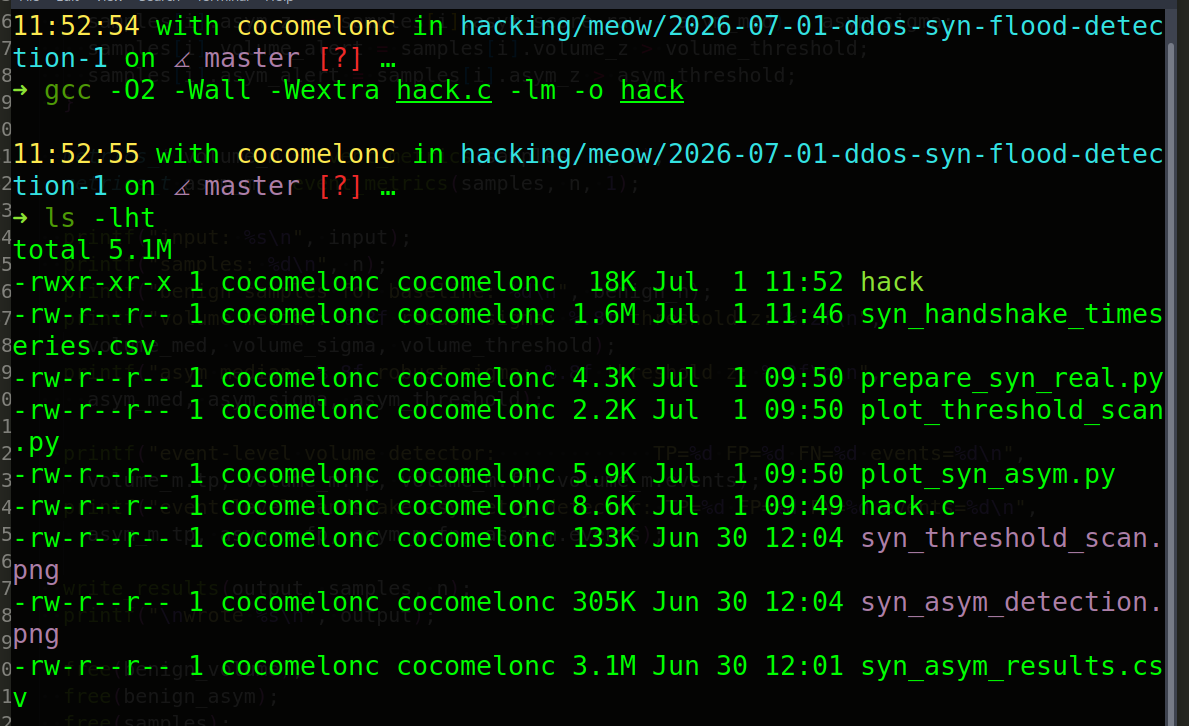
First of all, compile the C detector:
gcc -O2 -Wall -Wextra hack.c -lm -o hack
Run with equal robust z-score thresholds for both detectors:
./hack syn_handshake_timeseries.csv syn_asym_results.csv 8 8
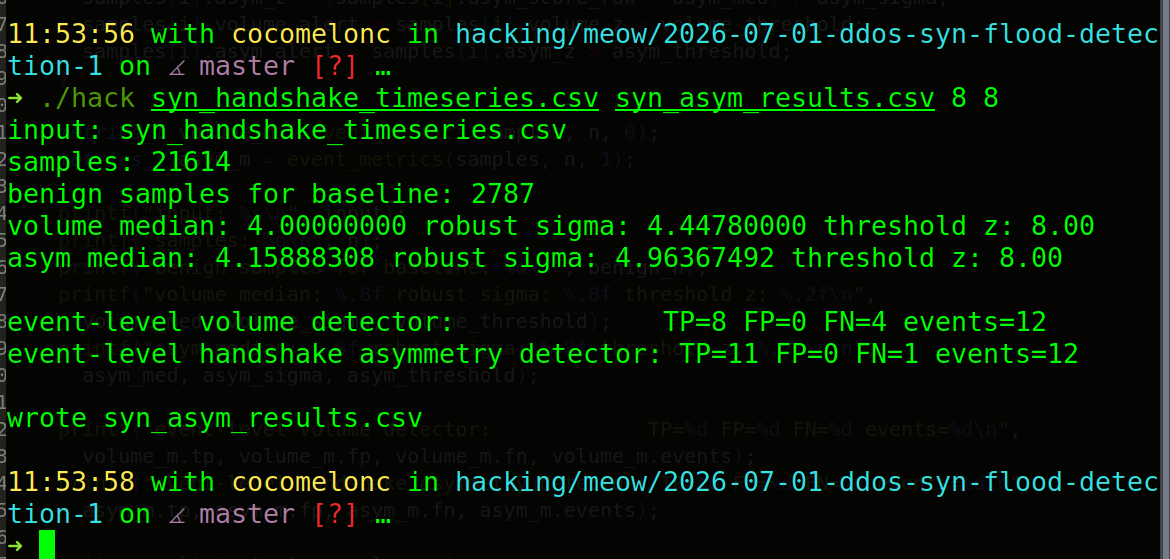
In my case:
input: syn_handshake_timeseries.csv
samples: 21614
benign samples for baseline: 2787
volume median: 4.00000000 robust sigma: 4.44780000 threshold z: 8.00
asym median: 4.15888308 robust sigma: 4.96367492 threshold z: 8.00

event-level volume detector:             TP=8 FP=0 FN=4 events=12
event-level handshake asymmetry detector: TP=11 FP=0 FN=1 events=12

wrote syn_asym_results.csv
The important result:
volume detector:              TP=8  FP=0 FN=4
handshake asymmetry detector: TP=11 FP=0 FN=1
At the same threshold \(z=8\), both detectors have zero false positives at campaign level. But handshake asymmetry detects more SYN campaigns.
campaign-level events
Raw CICDDoS2019 labels are per second after aggregation. Attack labels can be intermittent. For DDoS detection, it is usually more useful to evaluate incident/campaign detection, not every individual second.
So I merge attack-labeled seconds into one campaign when the gap between them is at most:
60 seconds
This is the campaign event definition:
\[event_i = \{t_s,\ldots,t_e\}\]where consecutive attack-labeled seconds separated by:
\[\Delta t \le 60\]belong to the same campaign.
A campaign is detected if at least one alert happens inside the campaign or within a small grace window:
\[t \in [t_s, t_e + 3]\]This avoids punishing a detector for alerting on the immediate boundary of the same attack.
plots
Then, generate the main plot:
python3 plot_syn_asym.py
Result:
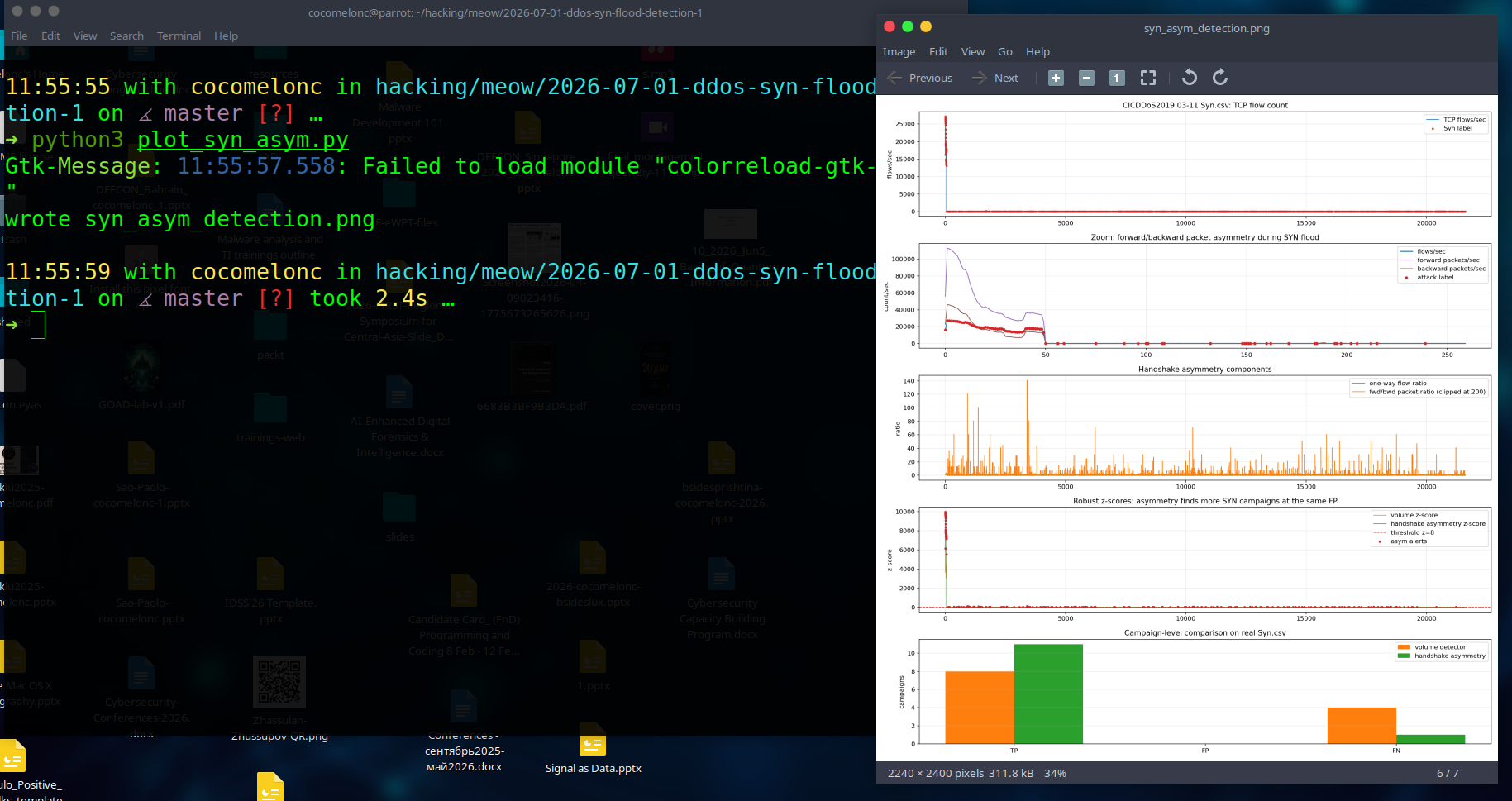
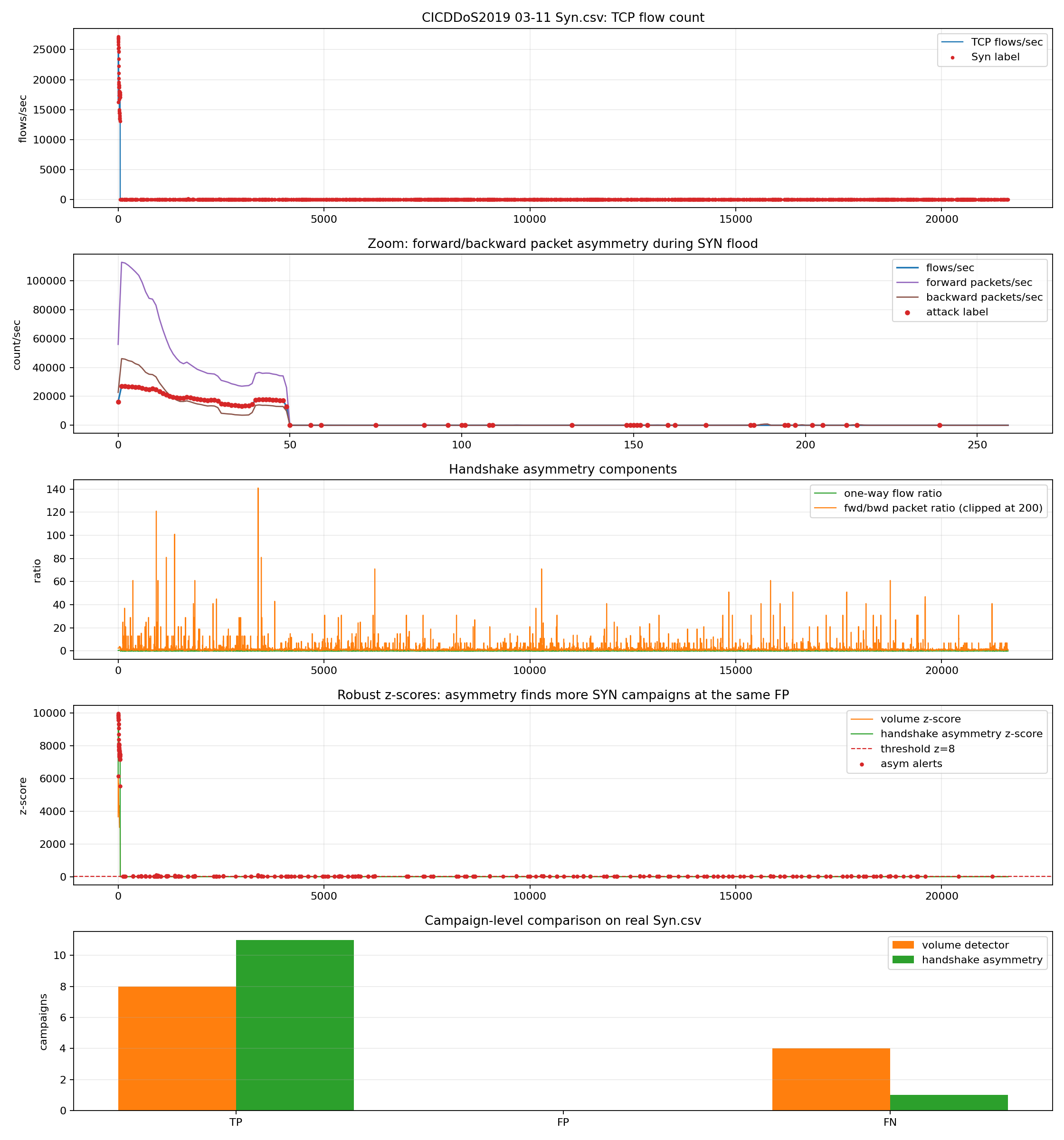
The plot contains:
- real TCP flows/sec from
Syn.csv; - zoom into a SYN campaign;
- forward/backward asymmetry components;
- robust z-scores;
- campaign-level TP/FP/FN comparison.
Then generate threshold scan:
python3 plot_threshold_scan.py
Result:
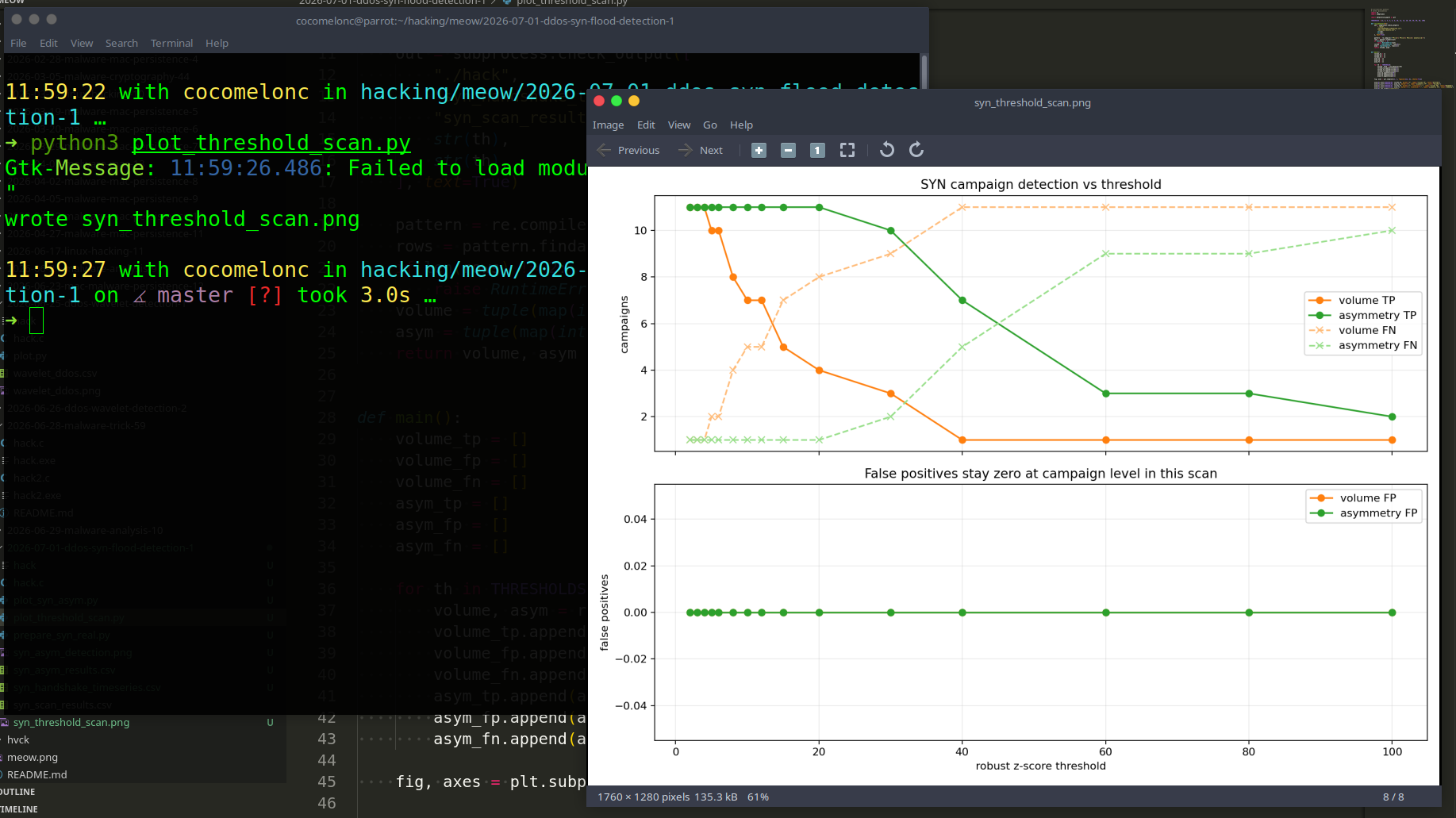
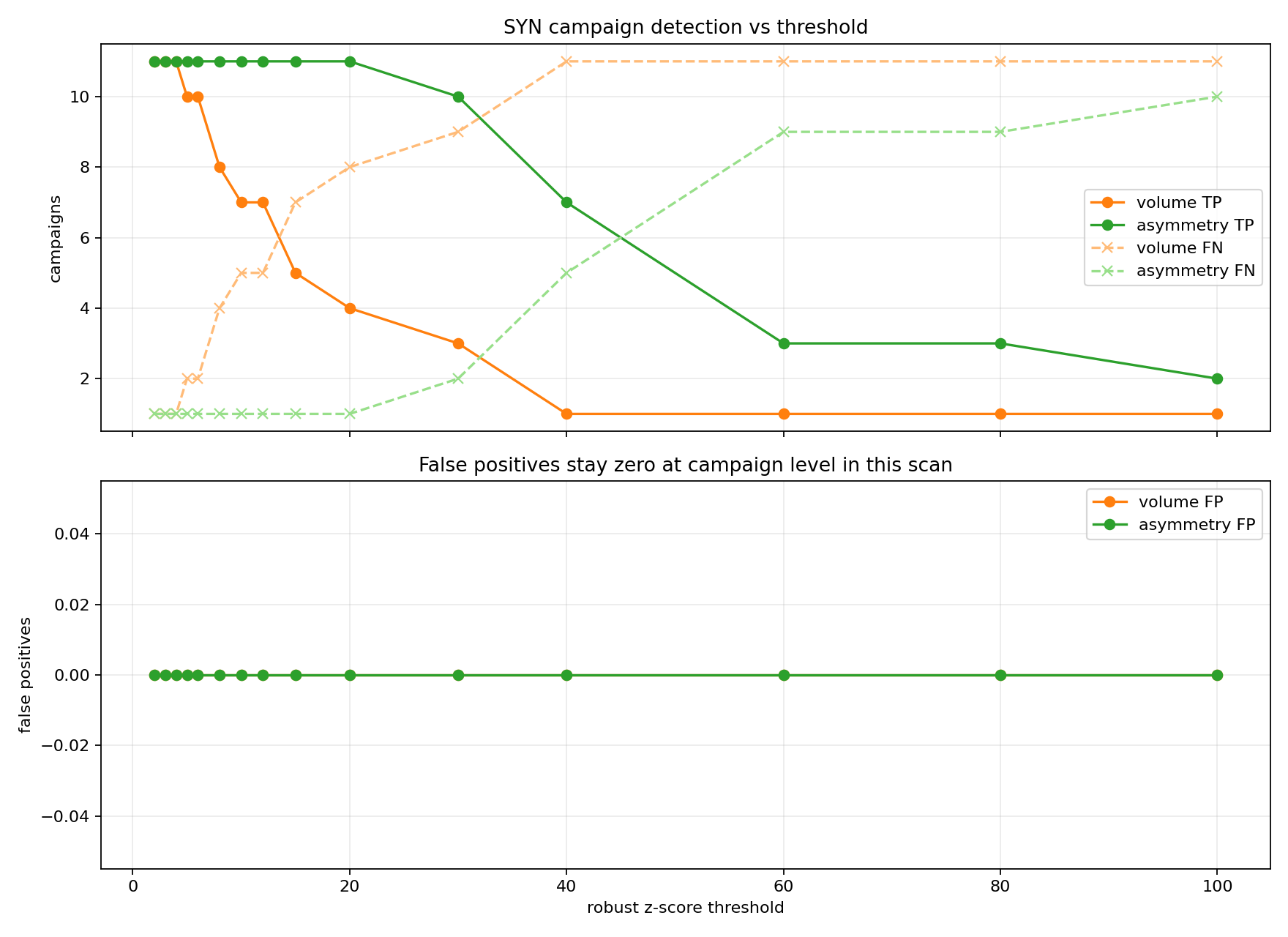
This plot is important because it shows the result is not only one lucky threshold. Across a wide threshold range, handshake asymmetry keeps more true positives than volume-only detection while false positives stay zero at campaign level in this experiment.
proof that this works
Mathematical proof:
Volume-only detection uses:
\[V_t=flows_t\]It ignores whether those flows are balanced by response traffic.
Handshake asymmetry uses:
\[A_t = flows_t \cdot \log(1 + R_t) \cdot (1 + O_t)\]with:
\[R_t = \frac{F_t + 1}{B_t + 1}\]and:
\[O_t = \frac{W_t}{flows_t}\]If traffic volume is high and response side is weak:
\[flows_t \uparrow,\quad R_t \uparrow,\quad O_t \uparrow\]then:
\[A_t \gg V_t\]relative to benign baseline.
If traffic volume rises but forward/backward behavior remains balanced:
\[R_t \approx 1,\quad O_t \approx 0\]then asymmetry does not grow as aggressively.
That is exactly the cybersecurity idea:
not just “many flows”
but “many connection attempts with abnormal response symmetry”
Practical proof on real CICDDoS2019 Syn.csv:
volume detector:              TP=8  FP=0 FN=4
handshake asymmetry detector: TP=11 FP=0 FN=1
So:
\[TP_{asym}-TP_{volume}=11-8=3\] \[FN_{volume}-FN_{asym}=4-1=3\] \[FP_{volume}=FP_{asym}=0\]At the same threshold \(z=8\), handshake asymmetry detects 3 more campaigns without increasing false positives.
Threshold scan proof:
At multiple thresholds, handshake asymmetry remains stronger. For example:
z=5:  volume TP=10 FN=2, asymmetry TP=11 FN=1
z=8:  volume TP=8  FN=4, asymmetry TP=11 FN=1
z=20: volume TP=4  FN=8, asymmetry TP=11 FN=1
This is useful because a detector that only works at one threshold is fragile. A detector that dominates across a range is more reliable.
limitations
This is not perfect TCP state tracking.
CICFlowMeter gives flow features, not raw kernel connection state. So:
Total Fwd PacketsandTotal Backward Packetsare proxy values;SYN Flag Countmay not fully represent all SYN packets after flow aggregation;- labels are dataset labels, not real-time ground truth;
- campaign merge gap changes event-level metrics.
For production-grade SYN flood detection, I would add:
- SYN packets/sec;
- SYN-ACK packets/sec;
- final ACK packets/sec;
- half-open connection table pressure;
- SYN cookie counters;
- conntrack drops;
- listen queue overflows;
- server p99 latency.
The better score would be:
\[S_t = w_1Z_{flows}+ w_2Z_{syn/synack}+ w_3Z_{halfopen}+ w_4Z_{queue\_drops}+ w_5Z_{handshake\_asym}\]But this post intentionally stays with fields available in CICDDoS2019 CSV and a simple C implementation.
conclusion
The main lesson:
SYN flood detection should not be only volume-based. It should measure handshake asymmetry.
On real CICDDoS2019 Syn.csv, the simple asymmetry score:
outperformed a plain flow-volume detector at campaign level:
volume:     TP=8  FP=0 FN=4
asymmetry:  TP=11 FP=0 FN=1
This is a practical defensive building block for Anti-DDoS research.
H. Wang, D. Zhang, K. G. Shin. Detecting SYN Flooding Attacks (IEEE INFOCOM, 2002) - pdf. Non-parametric CUSUM applied to the SYN-FIN difference; directly relevant to SYN-flood detection.
DDoS2019 Dataset: Canadian Institute for Cybersecurity
CICDoS2019 Dataset: Telegram channel
source code in github
This is a practical defensive case for educational purposes only.
Thanks for your time happy hacking and good bye!
PS. All drawings and screenshots are mine