Reversing embedded WebAssembly: part 2. Recovering function names from a WAMR .aot in pure C.
﷽
Hello, cybersecurity enthusiasts and white hackers!
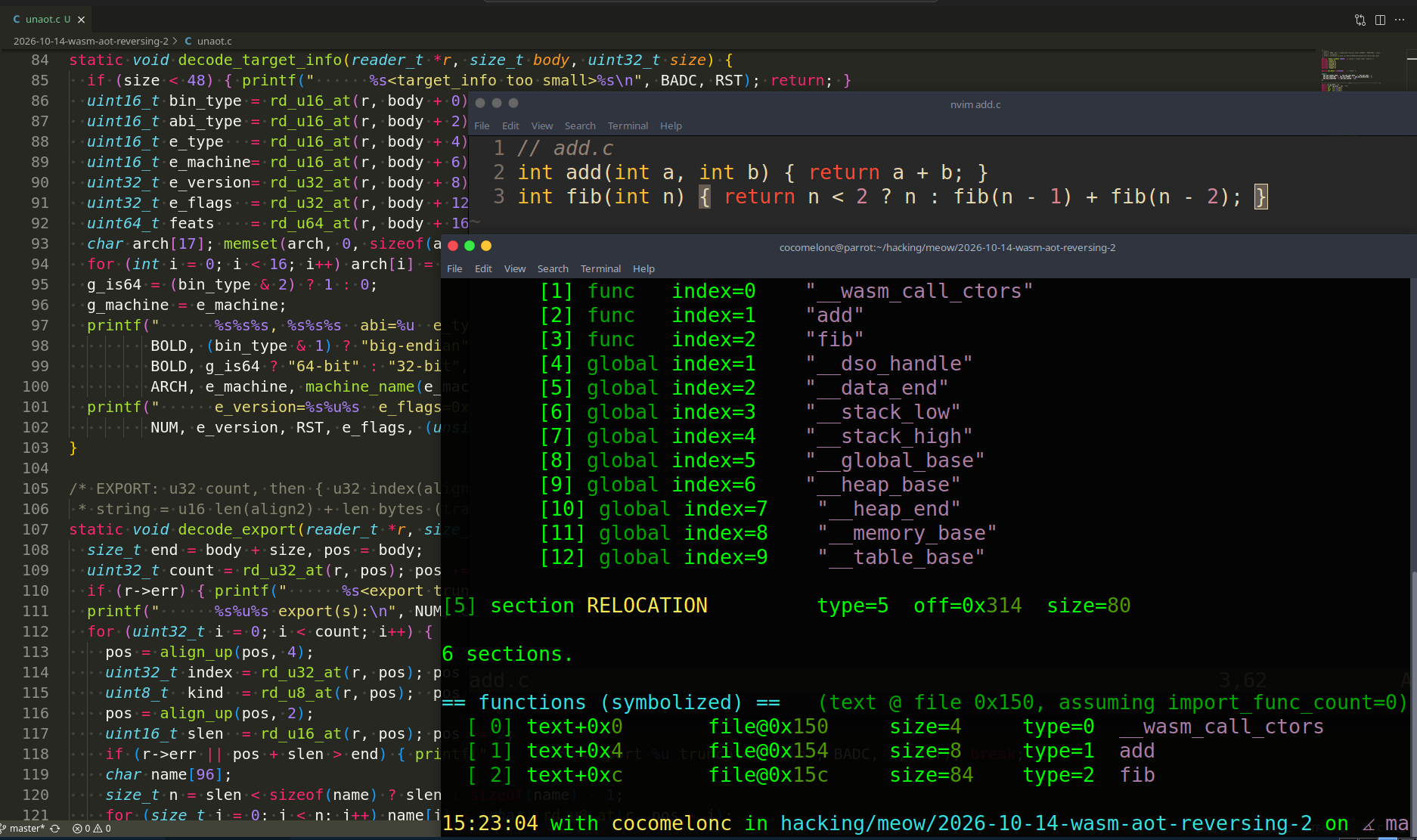
In part 1 we reversed the WAMR .aot container from real bytes and wrote unaot - a tiny, dependency-free C parser that verifies the \0aot magic, walks the section table (handling the 4-byte alignment rule), and decodes TARGET_INFO so we know exactly which CPU the embedded TEXT blob is compiled for.
That told us where the native code is and how to disassemble it. But a disassembly of a few hundred anonymous functions is nearly useless. What a reverse engineer actually wants is names: which blob of machine code is add, which is fib, which is the exported entry point. This part builds exactly that - a symbolized function table - by decoding two more sections, EXPORT and FUNCTION, and joining them. We will also give the tool some color so the output is readable. Still one small C file, still no libraries.
the plan
The information we need is split across two sections, and neither one is enough on its own:
FUNCTIONgives us, for every defined function, the offset intoTEXTwhere its native code starts (and its type index). It gives us the geography - but no names.EXPORTgives us names mapped to function indices - but no offsets.
The two share a key: the function index. So the whole trick of part 2 is:
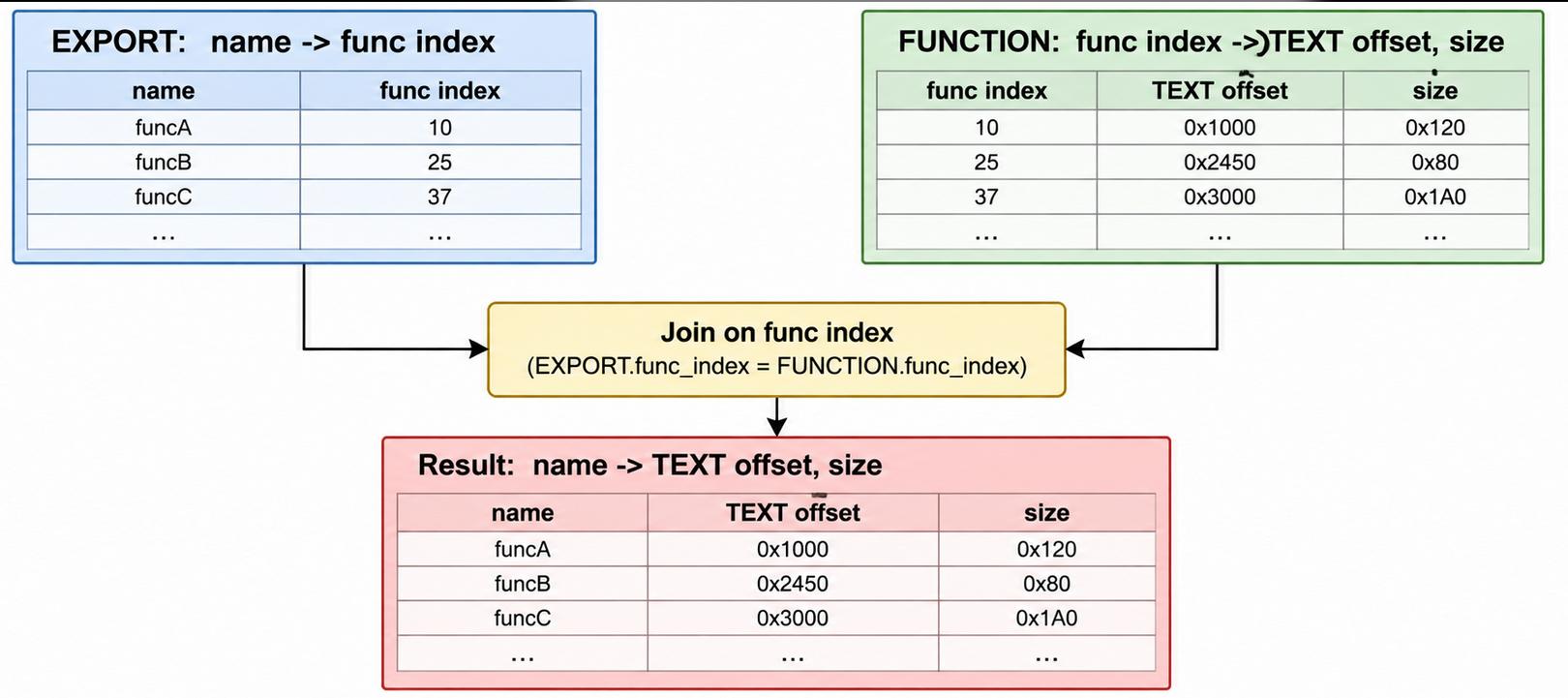
Decode both, join on the index, and we have a symbol table that maps every native function to a name and a precise file offset. Let’s take the sections one at a time.
the EXPORT section
EXPORT is the name source. Its layout (from WAMR’s aot_loader.c, load_export_section) is a count followed by that many export entries:
u32 count
entry[count]:
    u32  index          (4-byte aligned)
    u8   kind           0=func 1=table 2=memory 3=global 4=tag
    str  name
The one part that will trip you up is how WAMR stores a string. It is not a plain C string and not a bare length-prefixed buffer. It is:
u16 length          (2-byte aligned)
u8  bytes[length]    <- the trailing '\0' IS counted in length
So a name like add is stored with length = 4: the three characters a, d, d, plus a trailing NUL that is included in the count. If you print length bytes you get a stray NUL at the end; if you assume the length excludes the terminator you read one byte short on the next field and desync. We copy length bytes and then drop the last one.
Here is decode_export. Note the two alignment steps - index is 4-aligned, the string length is 2-aligned - mirroring the loader’s alignment-aware reads from part 1:
/* EXPORT: u32 count, then { u32 index(align4), u8 kind, string name }.
 * string = u16 len(align2) + len bytes (trailing '\0' counted in len). */
static void decode_export(reader_t *r, size_t body, uint32_t size) {
  size_t end = body + size, pos = body;
  uint32_t count = rd_u32_at(r, pos); pos += 4;
  if (r->err) { printf("      <export truncated>\n"); return; }
  printf("      %u export(s):\n", count);
  for (uint32_t i = 0; i < count; i++) {
    pos = align_up(pos, 4);
    uint32_t index = rd_u32_at(r, pos); pos += 4;
    uint8_t  kind  = rd_u8_at(r, pos);  pos += 1;
    pos = align_up(pos, 2);
    uint16_t slen  = rd_u16_at(r, pos); pos += 2;
    if (r->err || pos + slen > end) { printf("        <export %u truncated>\n", i); break; }
    char name[96];
    size_t n = slen < sizeof(name) ? slen : sizeof(name) - 1;
    for (size_t j = 0; j < n; j++) name[j] = (char) rd_u8_at(r, pos + j);
    name[n ? n - 1 : 0] = 0;   /* drop the counted trailing '\0' */
    pos += slen;
    printf("        [%u] %-6s index=%-3u  \"%s\"\n",
           i, export_kind_name(kind), index, name);
    if (kind == 0 && g_expn < MAXF) {   /* remember func names for symbolization */
      g_exp[g_expn].index = index;
      snprintf(g_exp[g_expn].name, sizeof(g_exp[g_expn].name), "%s", name);
      g_expn++;
    }
  }
}
Every access still goes through the bounds-checked reader, and we clamp against the section end before touching a name - a corrupt .aot must never walk us off the buffer. We keep only the kind == 0 (function) exports in a small table g_exp[]; that is our index-to-name map.
the FUNCTION section
FUNCTION is the geography. Its body is two parallel arrays:
text_offsets[func_count]        (u64 on a 64-bit target, else u32)
func_type_indexes[func_count]   (u32 each)
text_offsets[i] is the byte offset into TEXT where defined function i begins; the size of function i is simply text_offsets[i+1] - text_offsets[i] (and the last one runs to the end of TEXT).
There is a genuinely annoying catch, and it is worth dwelling on because it is the hardest part of the whole tool. func_count is not stored in this section. In WAMR it lives deep inside INIT_DATA, behind the memory, table, type, import-global, global and import-function tables - a lot of variable-length structures we have not decoded yet. Rather than parse all of INIT_DATA just to learn one integer, we derive func_count from the section size and then validate the guess.
If there were no other data, func_count = size / (word_size + 4) - one word per text_offset, one u32 per type index. But a wamrc built with stack-frame support (the prebuilt one is) emits two extra u32 arrays per function, so each entry is word_size + 4 + 8 bytes instead. We do not know up front which layout a given file uses, so we try both and keep the one that validates. A layout is accepted only if:
- the section size divides evenly by the per-entry size, and
- every decoded
text_offsetis withinTEXT, and the offsets are non-decreasing (functions are laid out in order).
That second check is what makes the guess safe: a wrong layout produces offsets that are out of range or out of order almost immediately, so it gets rejected.
/* try to read the FUNCTION section assuming `extra` bytes of per-func trailing
 * arrays (0 = no stack-frame info). returns func_count on success, else 0. */
static uint32_t try_func_layout(reader_t *r, size_t body, uint32_t size, uint32_t extra) {
  uint32_t wsz = g_is64 ? 8 : 4;
  uint32_t entry = wsz + 4 + extra;
  if (entry == 0 || size % entry != 0) return 0;
  uint32_t fc = size / entry;
  if (fc == 0 || fc > MAXF) return 0;
  uint64_t prev = 0;
  for (uint32_t i = 0; i < fc; i++) {
    uint64_t o = g_is64 ? rd_u64_at(r, body + (size_t) i * 8)
                        : rd_u32_at(r, body + (size_t) i * 4);
    if (r->err || o >= g_code_size || (i > 0 && o < prev)) return 0; /* sorted, in-range */
    prev = o;
  }
  return fc;
}

/* FUNCTION: text_offsets[fc] then func_type_indexes[fc] (u32). fc is not in
 * this section (it lives in INIT_DATA), so derive it and validate. */
static void decode_function(reader_t *r, size_t body, uint32_t size) {
  if (g_code_size == 0) { printf("      <no TEXT seen yet>\n"); return; }
  uint32_t wsz = g_is64 ? 8 : 4;
  uint32_t fc = try_func_layout(r, body, size, 0);   /* no stack-frame info  */
  if (!fc) fc = try_func_layout(r, body, size, 8);    /* + 2 u32 frame arrays */
  if (!fc) { printf("      <could not determine func_count>\n"); return; }

  for (uint32_t i = 0; i < fc; i++)
    g_foff[i] = g_is64 ? rd_u64_at(r, body + (size_t) i * 8)
                       : rd_u32_at(r, body + (size_t) i * 4);
  size_t tbase = body + (size_t) fc * wsz;
  for (uint32_t i = 0; i < fc; i++) g_ftype[i] = rd_u32_at(r, tbase + (size_t) i * 4);
  g_fcount = fc;
  printf("      %u function(s) (func index -> TEXT offset)\n", fc);
}
For our add.aot this correctly recovers 3 functions even though 60 / (8 + 4) = 5 is what a naive reader would print - because the prebuilt wamrc uses the stack-frame layout, so the real entry size is 8 + 4 + 8 = 20 and 60 / 20 = 3.
joining them into a symbol table
Now the payoff. func_export_name() looks a name up by function index, and print_symbol_table() walks the functions in order, computes each one’s size from the next offset, and prints the native + file offsets next to the recovered name:
/* name for defined function index i (assumes import_func_count == 0, which
 * holds for self-contained modules - see the caveat at the end). */
static const char *func_export_name(uint32_t i) {
  for (uint32_t k = 0; k < g_expn; k++) if (g_exp[k].index == i) return g_exp[k].name;
  return NULL;
}

static void print_symbol_table(void) {
  if (g_fcount == 0) return;
  printf("\n== functions (symbolized) ==   (text @ file 0x%x, assuming import_func_count=0)\n",
         g_text_foff);
  for (uint32_t i = 0; i < g_fcount; i++) {
    uint64_t foff = g_foff[i];
    uint64_t fend = (i + 1 < g_fcount) ? g_foff[i + 1] : g_code_size;
    uint64_t fsz  = fend > foff ? fend - foff : 0;
    uint64_t file_off = (uint64_t) g_text_foff + foff;
    const char *nm = func_export_name(i);
    printf("  [%2u] text+0x%-6llx  file@0x%-6llx  size=%-4llu  type=%u  %s\n",
           i, (unsigned long long) foff, (unsigned long long) file_off,
           (unsigned long long) fsz, g_ftype[i], nm ? nm : "");
  }
}
The file@ column is the real byte offset you can seek to in a hex editor or feed to a disassembler; text+ is the offset relative to the start of the code. That is the bridge from “a native blob at offset 0x150” to “the function fib is 56 bytes at file offset 0x170”.
a bit of color
Walls of monochrome offsets are hard to scan, so the real unaot.c wraps every field in a tiny color helper. The whole mechanism is one global and one macro - colors are emitted only when enabled, so piping to a file or grep stays clean:
static int g_color = 0;
#define CC(s) (g_color ? (s) : "")
#define RST   CC("\x1b[0m")
#define SEC   CC("\x1b[1;33m")   /* bold yellow  */
#define NUM   CC("\x1b[32m")     /* green        */
#define SYM   CC("\x1b[1;35m")   /* bold magenta */
/* ... */
We turn it on automatically when stdout is a terminal, and let the user force it either way. This also respects the NO_COLOR convention:
g_color = !no_color && (force_color || (isatty(fileno(stdout)) && !getenv("NO_COLOR")));
--color forces it on (handy for less -R), --no-color forces it off, and NO_COLOR=1 in the environment disables it - the listings in this post use --no-color so they paste cleanly.
Full source code of part 2 (reader.h is unchanged from part 1):
/*
 * unaot.c
 * part 2: WAMR .aot -> symbolized function table (EXPORT + FUNCTION) + color.
 * author: cocomelonc
 * https://cocomelonc.github.io/reverse/2026/10/14/wasm-aot-reversing-2.html
 */
#define _POSIX_C_SOURCE 200809L  /* isatty / fileno under -std=c11 */
#include <stdio.h>
#include <stdlib.h>
#include <string.h>
#include <stdint.h>
#include <unistd.h>
#include "reader.h"

#define AOT_MAGIC 0x746f6100u    /* "\0aot" */

enum {
  AOT_SEC_TARGET_INFO = 0, AOT_SEC_INIT_DATA = 1, AOT_SEC_TEXT = 2,
  AOT_SEC_FUNCTION = 3, AOT_SEC_EXPORT = 4, AOT_SEC_RELOCATION = 5,
  AOT_SEC_SIGNATURE = 6, AOT_SEC_CUSTOM = 100,
};

/* ------------------------------- color ---------------------------------- */
static int g_color = 0;
#define CC(s) (g_color ? (s) : "")
#define RST   CC("\x1b[0m")
#define BOLD  CC("\x1b[1m")
#define DIM   CC("\x1b[2m")
#define TITLE CC("\x1b[1;36m")   /* bold cyan    */
#define SEC   CC("\x1b[1;33m")   /* bold yellow  */
#define NUM   CC("\x1b[32m")     /* green        */
#define SYM   CC("\x1b[1;35m")   /* bold magenta */
#define ARCH  CC("\x1b[1;34m")   /* bold blue    */
#define OKC   CC("\x1b[32m")
#define BADC  CC("\x1b[1;31m")

/* ---------------------------- collected state --------------------------- */
#define MAXF 8192
static int      g_is64 = 1;       /* target word size, from TARGET_INFO */
static uint16_t g_machine = 0;    /* ELF e_machine, from TARGET_INFO    */
static uint32_t g_text_foff = 0;  /* file offset of TEXT body           */
static uint32_t g_code_size = 0;  /* TEXT size                          */
static uint64_t g_foff[MAXF];     /* per-func TEXT offset               */
static uint32_t g_ftype[MAXF];    /* per-func type index                */
static uint32_t g_fcount = 0;
struct expfn { uint32_t index; char name[96]; };
static struct expfn g_exp[MAXF];  /* exported functions (kind=func)     */
static uint32_t g_expn = 0;

static const char *sec_name(uint32_t t) {
  switch (t) {
    case AOT_SEC_TARGET_INFO: return "TARGET_INFO";
    case AOT_SEC_INIT_DATA:   return "INIT_DATA";
    case AOT_SEC_TEXT:        return "TEXT (native code)";
    case AOT_SEC_FUNCTION:    return "FUNCTION";
    case AOT_SEC_EXPORT:      return "EXPORT";
    case AOT_SEC_RELOCATION:  return "RELOCATION";
    case AOT_SEC_SIGNATURE:   return "SIGNATURE";
    case AOT_SEC_CUSTOM:      return "CUSTOM";
    default:                  return "<unknown>";
  }
}
static const char *machine_name(uint16_t m) {
  switch (m) {
    case 0x03: return "x86 (i386)"; case 0x3e: return "x86_64";
    case 0x28: return "ARM (32)";   case 0xb7: return "AArch64";
    case 0xf3: return "RISC-V";     case 0x08: return "MIPS";
    case 0xdc: return "Xtensa (ESP32)"; default: return "<other>";
  }
}
static const char *export_kind_name(uint8_t k) {
  switch (k) { case 0: return "func"; case 1: return "table"; case 2: return "memory";
               case 3: return "global"; case 4: return "tag"; default: return "?"; }
}
static size_t align_up(size_t v, size_t a) { return (v + (a - 1)) & ~(a - 1); }

static const char *func_export_name(uint32_t i) {
  for (uint32_t k = 0; k < g_expn; k++) if (g_exp[k].index == i) return g_exp[k].name;
  return NULL;
}

static void decode_target_info(reader_t *r, size_t body, uint32_t size) {
  if (size < 48) { printf("      %s<target_info too small>%s\n", BADC, RST); return; }
  uint16_t bin_type = rd_u16_at(r, body + 0);
  uint16_t abi_type = rd_u16_at(r, body + 2);
  uint16_t e_type   = rd_u16_at(r, body + 4);
  uint16_t e_machine= rd_u16_at(r, body + 6);
  uint32_t e_version= rd_u32_at(r, body + 8);
  uint32_t e_flags  = rd_u32_at(r, body + 12);
  uint64_t feats    = rd_u64_at(r, body + 16);
  char arch[17]; memset(arch, 0, sizeof(arch));
  for (int i = 0; i < 16; i++) arch[i] = (char) rd_u8_at(r, body + 32 + i);
  g_is64 = (bin_type & 2) ? 1 : 0;
  g_machine = e_machine;
  printf("      %s%s%s, %s%s%s  abi=%u  e_type=%u  machine=%s0x%02x (%s)%s\n",
         BOLD, (bin_type & 1) ? "big-endian" : "little-endian", RST,
         BOLD, g_is64 ? "64-bit" : "32-bit", RST, abi_type, e_type,
         ARCH, e_machine, machine_name(e_machine), RST);
  printf("      e_version=%s%u%s  e_flags=0x%x  features=0x%016llx  arch=%s\"%s\"%s\n",
         NUM, e_version, RST, e_flags, (unsigned long long) feats, ARCH, arch, RST);
}

static void decode_export(reader_t *r, size_t body, uint32_t size) {
  size_t end = body + size, pos = body;
  uint32_t count = rd_u32_at(r, pos); pos += 4;
  if (r->err) { printf("      %s<export truncated>%s\n", BADC, RST); return; }
  printf("      %s%u%s export(s):\n", NUM, count, RST);
  for (uint32_t i = 0; i < count; i++) {
    pos = align_up(pos, 4);
    uint32_t index = rd_u32_at(r, pos); pos += 4;
    uint8_t  kind  = rd_u8_at(r, pos);  pos += 1;
    pos = align_up(pos, 2);
    uint16_t slen  = rd_u16_at(r, pos); pos += 2;
    if (r->err || pos + slen > end) { printf("        %s<export %u truncated>%s\n", BADC, i, RST); break; }
    char name[96];
    size_t n = slen < sizeof(name) ? slen : sizeof(name) - 1;
    for (size_t j = 0; j < n; j++) name[j] = (char) rd_u8_at(r, pos + j);
    name[n ? n - 1 : 0] = 0;
    pos += slen;
    printf("        [%u] %s%-6s%s index=%-3u  %s\"%s\"%s\n",
           i, DIM, export_kind_name(kind), RST, index, SYM, name, RST);
    if (kind == 0 && g_expn < MAXF) {
      g_exp[g_expn].index = index;
      snprintf(g_exp[g_expn].name, sizeof(g_exp[g_expn].name), "%s", name);
      g_expn++;
    }
  }
}

static uint32_t try_func_layout(reader_t *r, size_t body, uint32_t size, uint32_t extra) {
  uint32_t wsz = g_is64 ? 8 : 4;
  uint32_t entry = wsz + 4 + extra;
  if (entry == 0 || size % entry != 0) return 0;
  uint32_t fc = size / entry;
  if (fc == 0 || fc > MAXF) return 0;
  uint64_t prev = 0;
  for (uint32_t i = 0; i < fc; i++) {
    uint64_t o = g_is64 ? rd_u64_at(r, body + (size_t) i * 8)
                        : rd_u32_at(r, body + (size_t) i * 4);
    if (r->err || o >= g_code_size || (i > 0 && o < prev)) return 0;
    prev = o;
  }
  return fc;
}

static void decode_function(reader_t *r, size_t body, uint32_t size) {
  if (g_code_size == 0) { printf("      %s<no TEXT seen yet>%s\n", BADC, RST); return; }
  uint32_t wsz = g_is64 ? 8 : 4;
  uint32_t fc = try_func_layout(r, body, size, 0);
  if (!fc) fc = try_func_layout(r, body, size, 8);
  if (!fc) { printf("      %s<could not determine func_count>%s\n", BADC, RST); return; }

  for (uint32_t i = 0; i < fc; i++)
    g_foff[i] = g_is64 ? rd_u64_at(r, body + (size_t) i * 8)
                       : rd_u32_at(r, body + (size_t) i * 4);
  size_t tbase = body + (size_t) fc * wsz;
  for (uint32_t i = 0; i < fc; i++) g_ftype[i] = rd_u32_at(r, tbase + (size_t) i * 4);
  g_fcount = fc;
  printf("      %s%u%s function(s) (func index -> TEXT offset)\n", NUM, fc, RST);
}

static void print_symbol_table(void) {
  if (g_fcount == 0) return;
  printf("\n%s== functions (symbolized) ==%s   %s(text @ file 0x%x, assuming import_func_count=0)%s\n",
         TITLE, RST, DIM, g_text_foff, RST);
  for (uint32_t i = 0; i < g_fcount; i++) {
    uint64_t foff = g_foff[i];
    uint64_t fend = (i + 1 < g_fcount) ? g_foff[i + 1] : g_code_size;
    uint64_t fsz  = fend > foff ? fend - foff : 0;
    uint64_t file_off = (uint64_t) g_text_foff + foff;
    const char *nm = func_export_name(i);
    printf("  %s[%2u]%s text+0x%s%-6llx%s  file@0x%s%-6llx%s  size=%s%-4llu%s  type=%u  %s%s%s\n",
           DIM, i, RST,
           NUM, (unsigned long long) foff, RST,
           NUM, (unsigned long long) file_off, RST,
           NUM, (unsigned long long) fsz, RST, g_ftype[i],
           SYM, nm ? nm : "", RST);
  }
}

static uint8_t *read_file(const char *path, size_t *out_len) {
  FILE *fp = fopen(path, "rb");
  if (!fp) { perror(path); return NULL; }
  fseek(fp, 0, SEEK_END); long sz = ftell(fp); fseek(fp, 0, SEEK_SET);
  if (sz < 0) { fclose(fp); return NULL; }
  uint8_t *buf = malloc((size_t) sz ? (size_t) sz : 1);
  if (!buf) { fclose(fp); return NULL; }
  *out_len = fread(buf, 1, (size_t) sz, fp);
  fclose(fp);
  return buf;
}

int main(int argc, char **argv) {
  const char *path = NULL;
  int force_color = 0, no_color = 0;
  for (int i = 1; i < argc; i++) {
    if (!strcmp(argv[i], "--color")) force_color = 1;
    else if (!strcmp(argv[i], "--no-color")) no_color = 1;
    else path = argv[i];
  }
  if (!path) { fprintf(stderr, "usage: %s [--color|--no-color] <file.aot>\n", argv[0]); return 2; }
  g_color = !no_color && (force_color || (isatty(fileno(stdout)) && !getenv("NO_COLOR")));

  size_t len = 0;
  uint8_t *buf = read_file(path, &len);
  if (!buf) return 1;
  reader_t r; rd_init(&r, buf, len);

  uint32_t magic = rd_u32_at(&r, 0), version = rd_u32_at(&r, 4);
  printf("%s== unaot: %s %s(%zu bytes)%s ==\n", TITLE, path, DIM, len, RST);
  printf("magic    : 0x%08x %s%s%s\n", magic,
         magic == AOT_MAGIC ? OKC : BADC,
         magic == AOT_MAGIC ? "(\\0aot ok)" : "(BAD - not a WAMR .aot)", RST);
  printf("version  : %s%u%s\n", NUM, version, RST);
  if (magic != AOT_MAGIC) { free(buf); return 1; }

  size_t p = 8; int n = 0;
  while (1) {
    p = align_up(p, 4);
    if (p + 8 > len) break;
    uint32_t type = rd_u32_at(&r, p), size = rd_u32_at(&r, p + 4);
    if (r.err) break;
    size_t body = p + 8;
    if (size > len - body) {
      printf("\n[%d] %s%s%s  %s<TRUNCATED>%s\n", n, SEC, sec_name(type), RST, BADC, RST);
      break;
    }
    printf("\n%s[%d]%s section %s%-18s%s type=%u  off=0x%s%zx%s  size=%s%u%s\n",
           DIM, n, RST, SEC, sec_name(type), RST, type, NUM, body, RST, NUM, size, RST);
    switch (type) {
      case AOT_SEC_TARGET_INFO: decode_target_info(&r, body, size); break;
      case AOT_SEC_TEXT:
        g_text_foff = (uint32_t) body; g_code_size = size;
        printf("      -> %snative machine code%s (%u bytes); disassemble per arch\n", BOLD, RST, size);
        break;
      case AOT_SEC_FUNCTION: decode_function(&r, body, size); break;
      case AOT_SEC_EXPORT:   decode_export(&r, body, size);   break;
      default: break;   /* RELOCATION: part 3 */
    }
    p = body + size; n++;
  }
  printf("\n%d sections.\n", n);
  print_symbol_table();
  free(buf);
  return 0;
}
demo
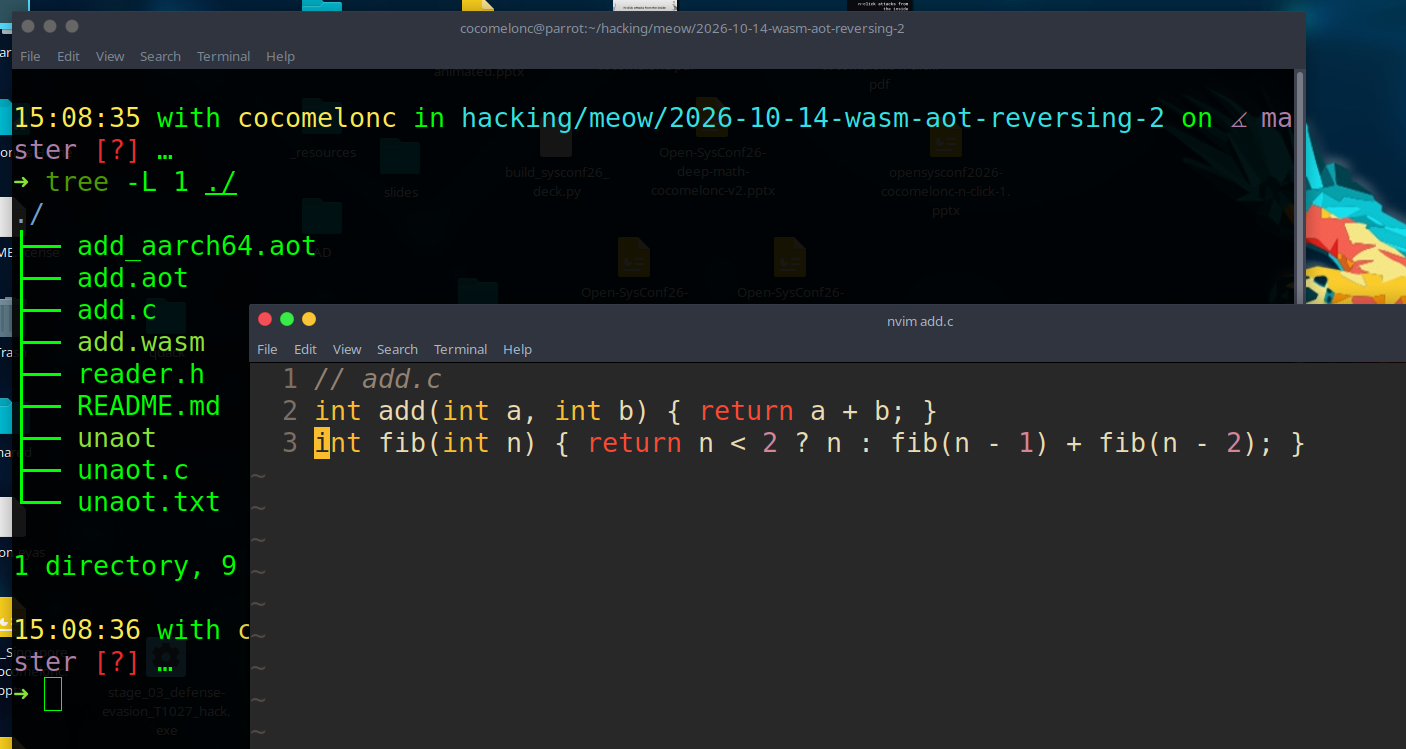
We reuse the add.aot from part 1 (the two-function add / fib module):
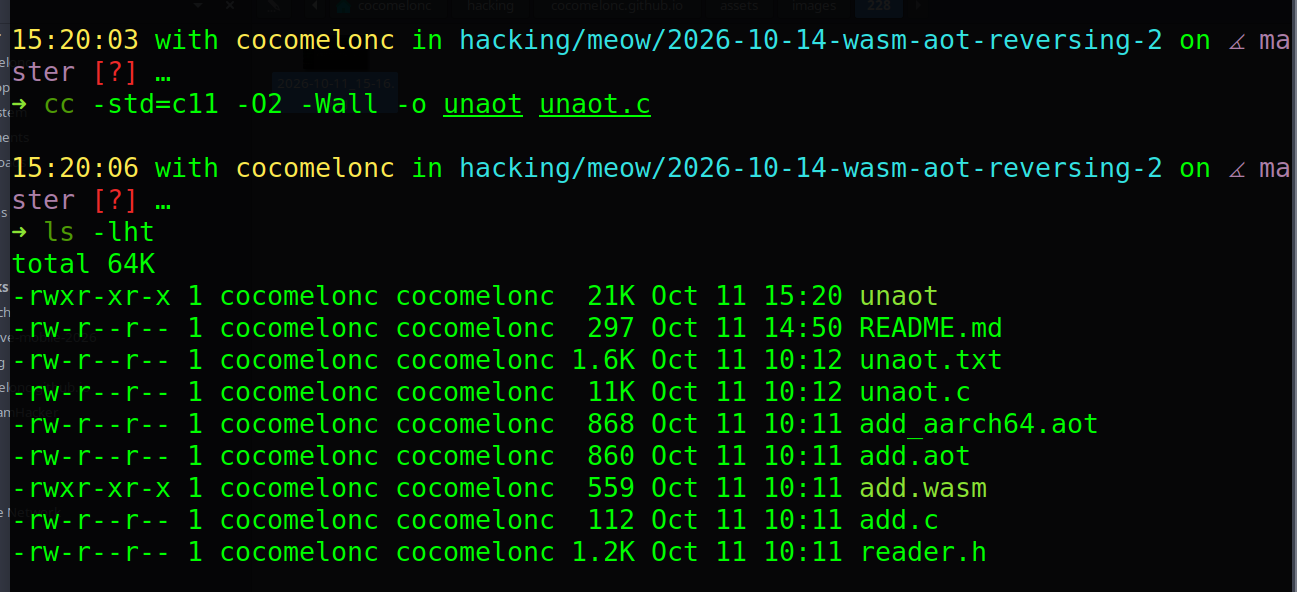
Build:
cc -std=c11 -O2 -Wall -o unaot unaot.c
and run:
./unaot add.aot
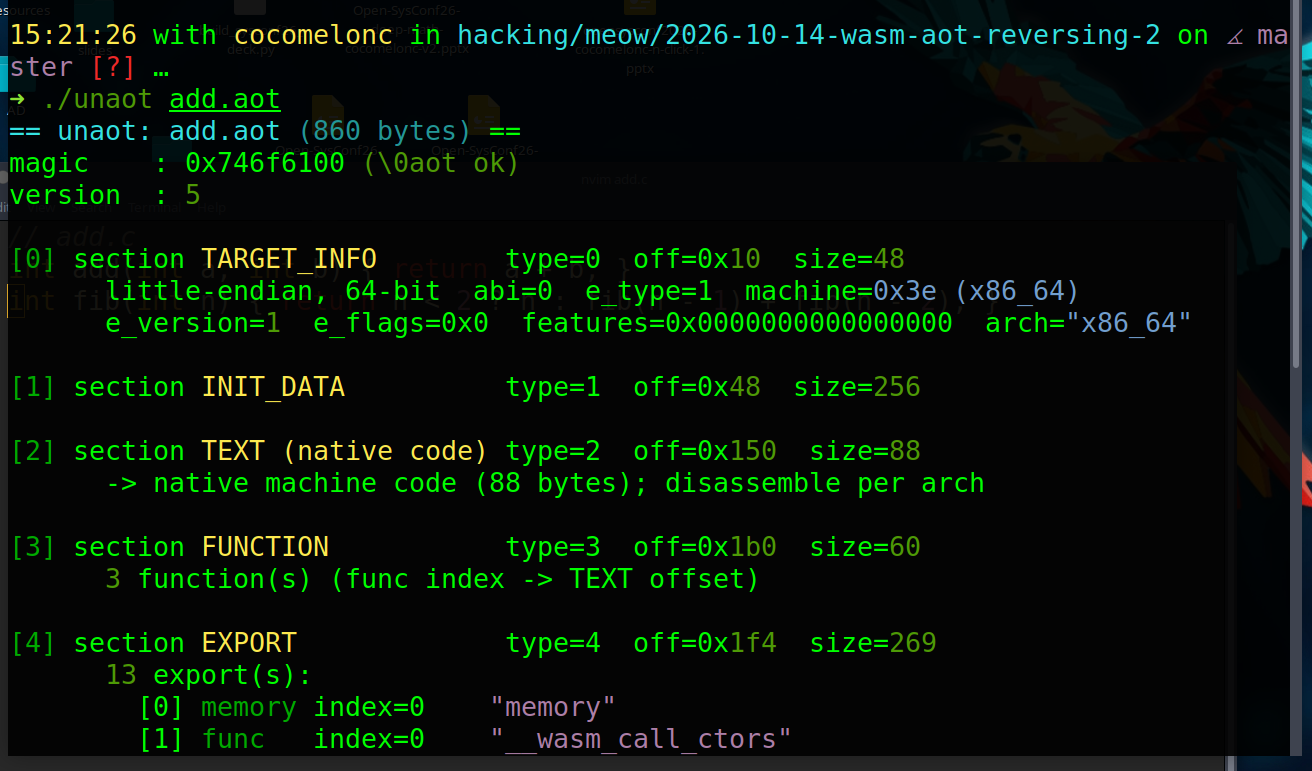
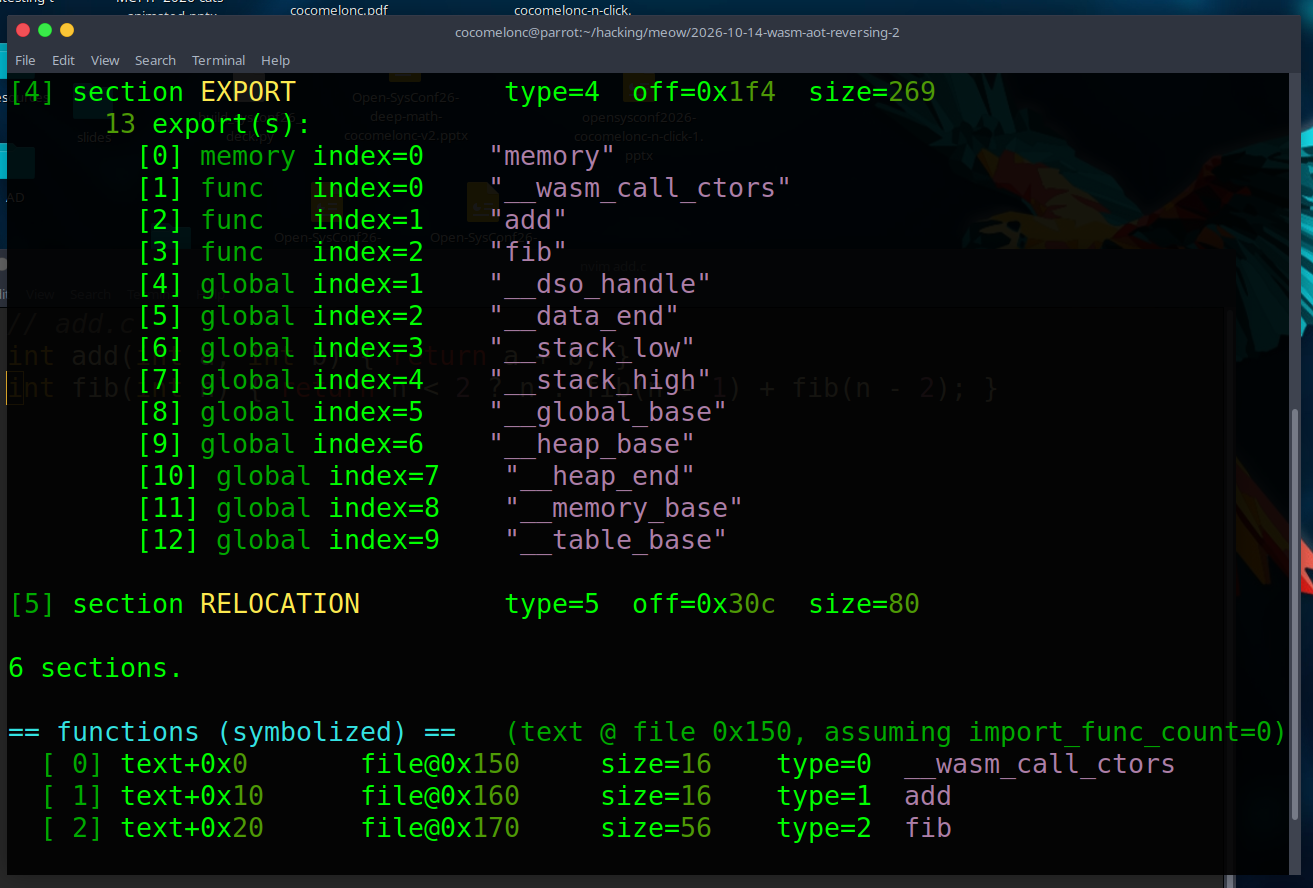
There it is - three native functions, each with a name, a file offset, and a size. The naive 60 / 12 = 5 trap is avoided: the validator picked the stack-frame layout and reported 3. add is the 16 bytes at file offset 0x160, fib the 56 bytes at 0x170. You can xxd -s 0x170 -l 56 add.aot and you are looking at exactly the compiled fib.
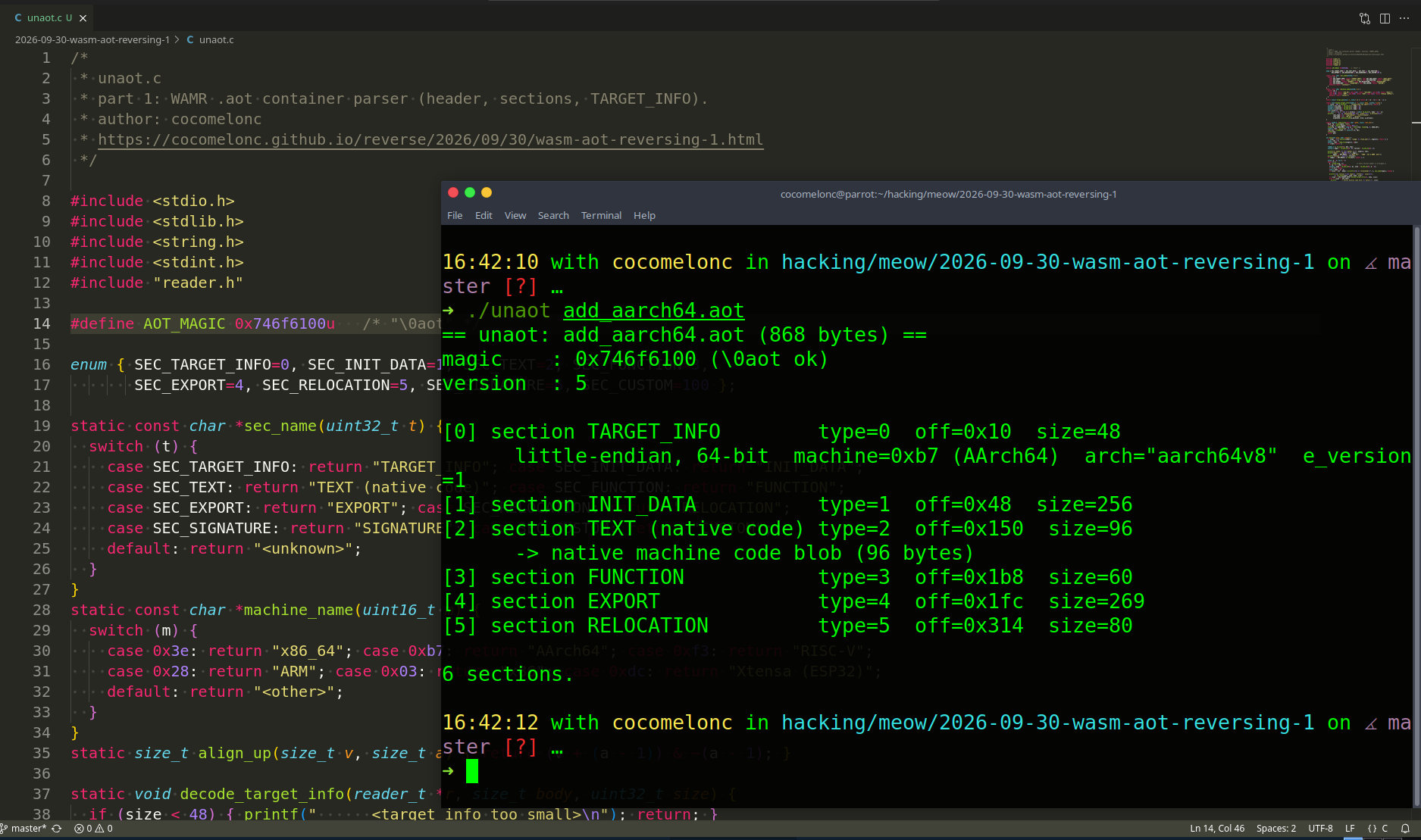
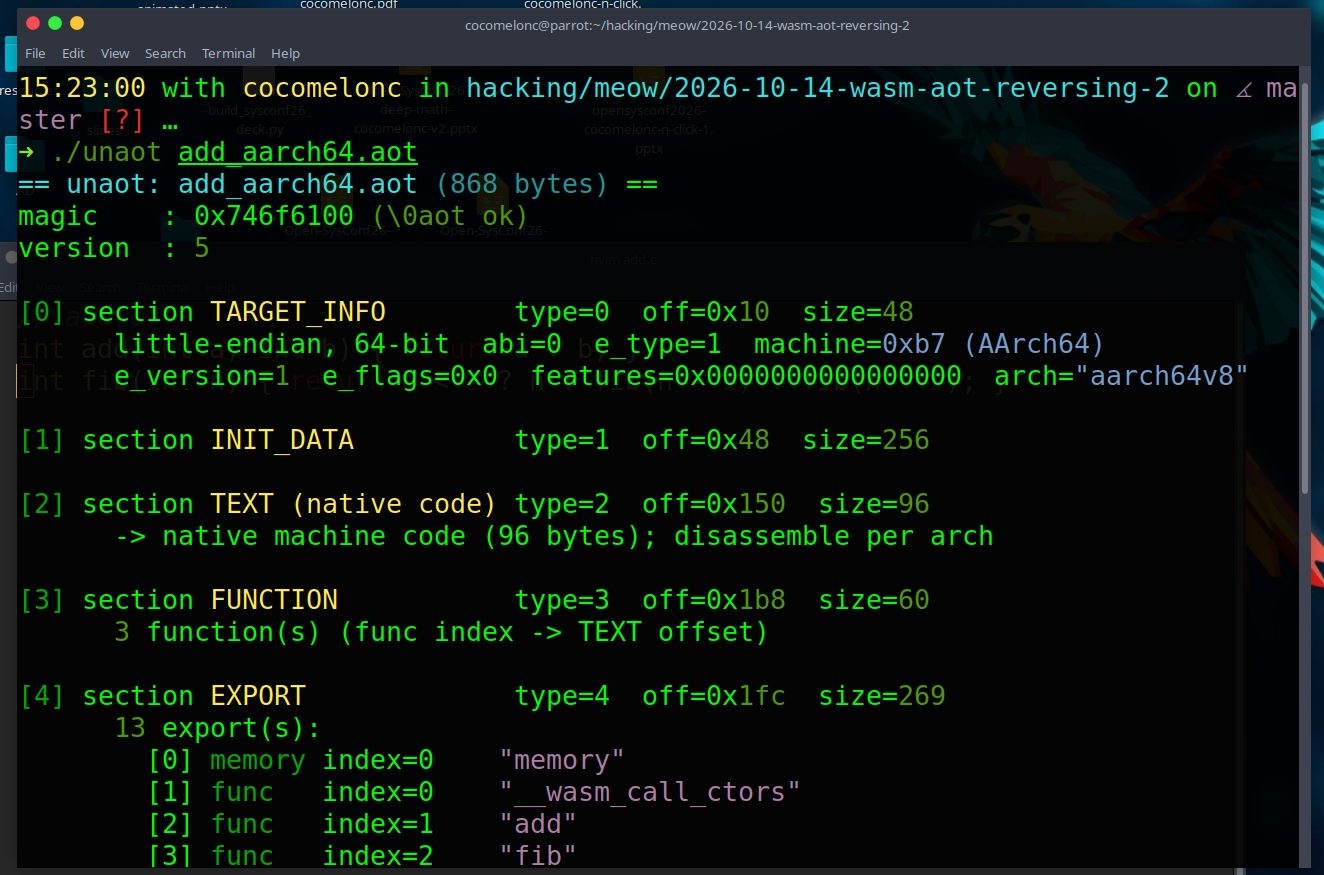
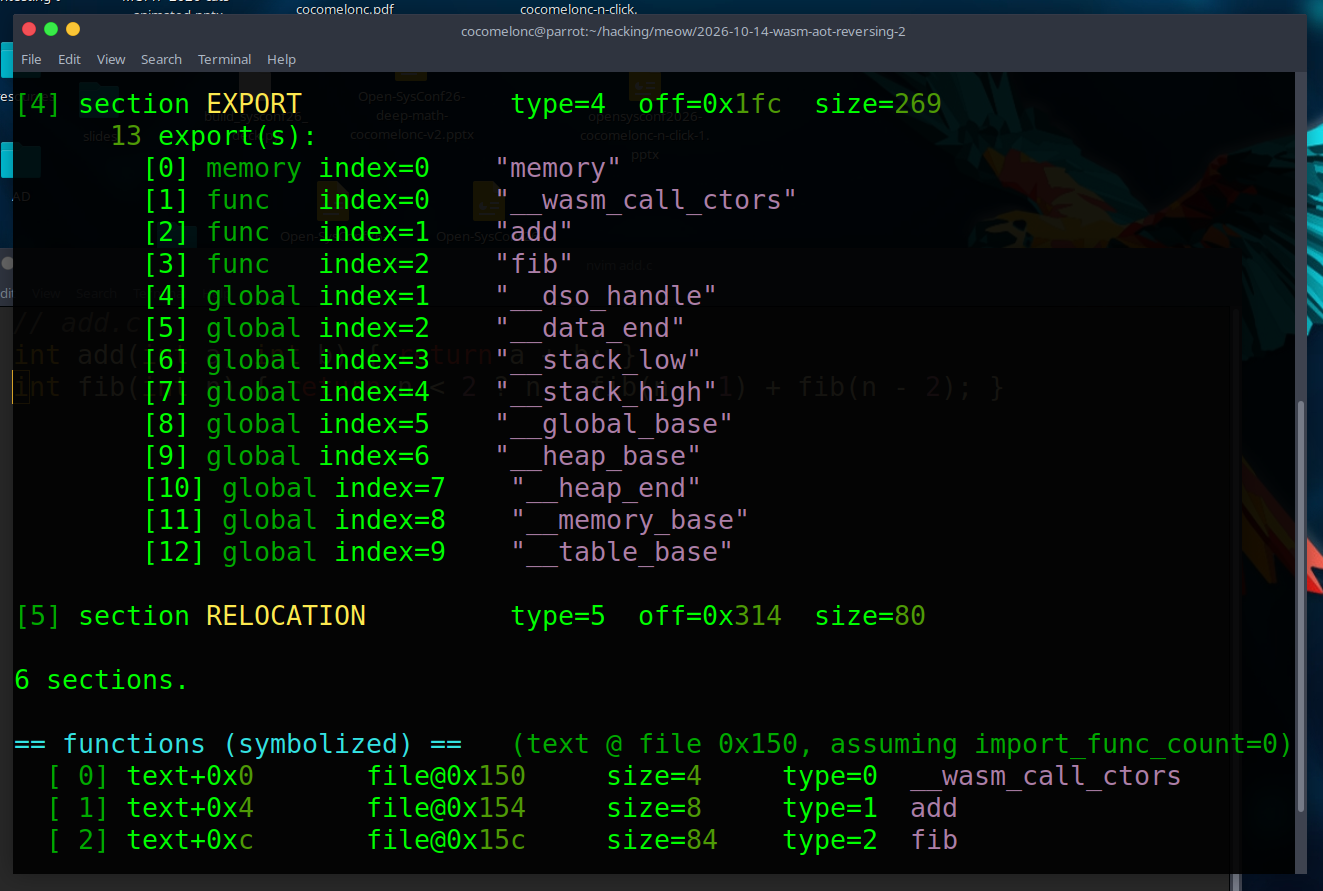
And just like in part 1, nothing here is architecture-specific. Run it on the aarch64 build and you get the same three names mapped onto AArch64 code - only the sizes change, because the instruction encodings differ:
./unaot add_aarch64.aot
One honest caveat, flagged right in the output. Our index-to-name join assumes import_func_count == 0 - i.e. the module imports no host functions, so defined function index i equals global function index i. That holds for a self-contained module like this one, but a real firmware module usually imports host/WASI functions, which shifts all the defined indices. You can already see the symptom on a real sample: Sony’s AITRIOS edge-app .aot files export __main_argc_argv at index 307 while only 289 functions are defined - the export indices are absolute and our table would mislabel them. Reading the true import_func_count out of INIT_DATA is the fix, and it is on the list.
You may also have noticed the RELOCATION section sitting there, decoded only as far as “here it is.” That is deliberate - relocations are how we recover cross-references between functions (including that recursive fib self-call), and they are the whole subject of part 3.
summary
| piece | what it does |
|---|---|
decode_export() |
names mapped to function indices (WAMR string: u16 len incl. NUL) |
decode_function() |
function index mapped to TEXT offset + type; derives func_count |
try_func_layout() |
guesses the per-entry layout and validates it (sorted, in-range) |
print_symbol_table() |
joins the two on the index -> name + file offset + size |
| color helpers | readable on a terminal, clean when piped (NO_COLOR aware) |
We now turn an anonymous native blob into a named function table - the thing you actually load into a disassembler. In the next part we decode the RELOCATION section to recover cross-references between functions, and then wrap everything into a Ghidra loader so you can open a .aot straight into Ghidra with arch, code, symbols and xrefs already in place.
I hope this post is useful for reverse engineers, embedded and IoT security researchers, and everyone curious about how WebAssembly really ships on devices.
WebAssembly Micro Runtime (WAMR)
WAMR AOT compiler (wamrc) and prebuilt releases
reversing embedded WebAssembly: part 1
WebAssembly core specification
source code in github - part 2
This is a practical case for educational purposes only.
Thanks for your time happy hacking and good bye!
PS. All drawings and screenshots are mine